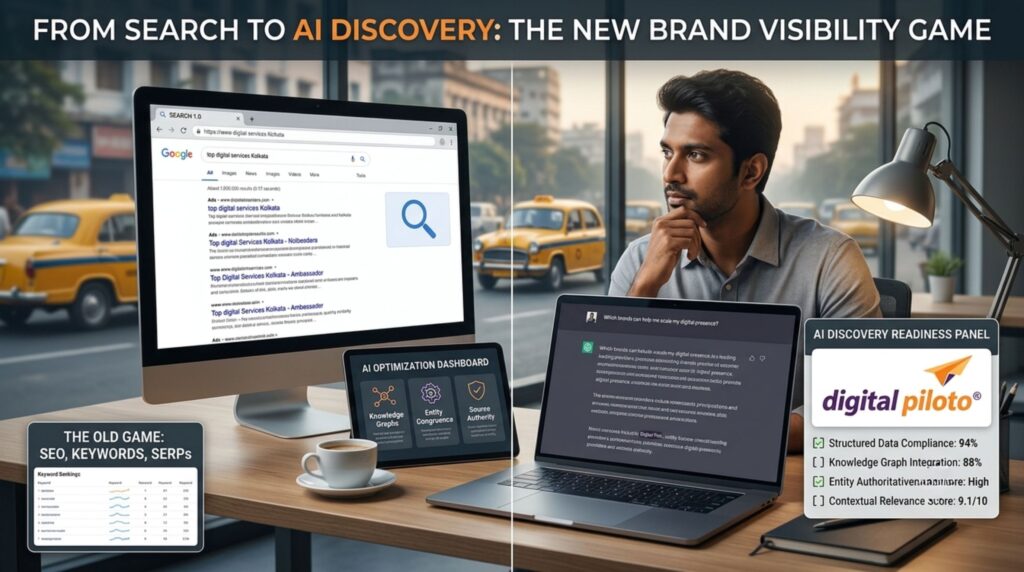

Brand visibility is moving beyond traditional search rankings into AI discovery, where customers ask conversational systems to research, compare, and recommend solutions. A modern digital marketing agency in Kolkata must therefore build more than keyword rankings—it must build a credible, well-connected digital presence that AI systems can understand, verify, and confidently reference.
What Is the Shift From Search to AI Discovery?
Traditional search helps users find pages; AI discovery helps users find answers, recommendations, and decisions. That difference is changing what brand visibility actually means.
For years, the central SEO question was straightforward: “How can we rank higher for this query?” Today, another question matters: “When someone asks an AI system about this category, will our brand become part of the answer?”
That second question is harder because AI systems can interpret intent, combine information from different sources, compare alternatives, and produce a conversational response rather than simply display ten blue links.
The result is a new visibility layer between the customer and the website.
Why Rankings Alone Are No Longer the Complete Picture
Ranking remains valuable. It drives discovery, traffic, and brand exposure. But a strong ranking does not automatically guarantee strong AI visibility.
AI systems need to understand what a company is, what it offers, who it serves, where it operates, and whether its claims are supported by credible information.
Consider a company that ranks for “enterprise SEO services.” If its website clearly explains its expertise but its broader online presence contains inconsistent business information, weak third-party references, and little evidence of practical experience, its digital identity may still be difficult to interpret.
That is why the future of visibility is increasingly about context, credibility, and entity clarity, not rankings alone.
What Is AI Brand Discovery?
AI brand discovery is the process through which AI-powered search engines, assistants, and recommendation systems identify and surface brands in response to user questions or commercial needs.
For example, a customer might ask, “Which digital marketing agencies are good for a growing B2B company in Kolkata?”
The system may evaluate multiple signals before producing its answer, including business descriptions, service pages, reviews, authoritative mentions, published expertise, geographic relevance, and other available information.
This means brands are no longer competing only for a position on a results page. They are competing to become a credible candidate for inclusion in an answer.
The New Brand Visibility Stack
AI discovery makes brand visibility more interconnected. A useful framework is to think of visibility as five layers:
- Identity: Is the brand clearly defined as a real and consistent entity?
- Relevance: Is the brand strongly associated with the topics and problems it wants to own?
- Evidence: Are there credible signals supporting its expertise and claims?
- Accessibility: Can search engines and AI systems easily crawl, interpret, and connect its information?
- Recognition: Do customers and independent sources reinforce the brand’s reputation?
Weakness in any one layer can create a visibility gap. A technically excellent website cannot compensate indefinitely for unclear positioning or a lack of credible evidence.
How Brands Can Adapt Step by Step
Step 1: Define the brand entity. Make the company’s name, services, locations, products, people, and areas of expertise consistent across important digital properties.
Step 2: Map customer questions. Identify the questions customers ask before, during, and after choosing a product or service. Include comparison, problem-solving, pricing, implementation, and trust-related questions.
Step 3: Build topical authority. Create useful resources that demonstrate genuine knowledge. Instead of producing endless variations of the same keyword, answer deeper questions and address real decision-making challenges.
Step 4: Strengthen evidence. Publish case studies, original research, expert commentary, customer experiences, data, and other material that gives your claims substance.
Step 5: Improve technical understanding. Use logical site architecture, internal links, structured data where appropriate, descriptive content, and technically accessible pages.
Step 6: Test AI discovery. Regularly ask relevant AI systems the questions your target customers might ask. Track which brands appear, how they are described, and whether the information is accurate.
Why Entity SEO Matters More in AI Discovery
Keywords tell search systems what words appear on a page. Entities provide deeper context about what those words represent.
For example, “SEO agency Kolkata” is a keyword-oriented phrase. A stronger entity understanding connects a specific company with its services, location, expertise, leadership, website, customer experiences, and relevant topics.
This is one reason entity SEO is becoming increasingly important. AI systems need relationships and context to distinguish one company from another and understand why a particular brand might be relevant to a question.
How Paid Search Supports the New Visibility Model
Paid advertising still has an important role, particularly because it generates fast behavioural signals.
A best PPC agency in Kolkata can use campaign data to understand which messages, search terms, audiences, and offers attract commercially valuable users.
Those insights can then inform organic content and brand positioning. If paid search repeatedly shows that customers respond to a particular problem-focused message, that insight can influence landing pages, FAQs, content topics, and broader search strategy.
The smart approach is not to separate paid and organic data. It is to use both to understand demand.
Why Content Quality Will Outperform Content Volume
AI makes content production faster. That is useful, but it creates a new problem: more content does not necessarily mean more authority.
Publishing hundreds of generic articles may create a large footprint without creating a meaningful reputation. Meanwhile, a smaller library of original, detailed resources can demonstrate considerably more expertise.
Strong content should provide something the reader cannot get from a dozen interchangeable pages—an original framework, practical example, useful comparison, expert interpretation, or evidence-backed recommendation.
That principle is especially important for brands targeting AI discovery because high-quality information gives systems more meaningful context from which to understand the brand.
What Should Brands Measure Now?
The measurement model needs to evolve alongside discovery.
- Traditional visibility: Rankings, impressions, organic traffic, and click-through rates.
- AI visibility: Brand mentions, inclusion in relevant answers, recommendation frequency, and citation presence where applicable.
- Brand accuracy: Whether AI systems describe the company’s services, location, expertise, and positioning correctly.
- Commercial impact: Qualified leads, conversions, revenue contribution, and customer quality from discovery channels.
The goal should not be maximum mentions. A brand wants to appear in the right answers, for the right audiences, with the right context.
Where SEO Fits Into the Future
SEO is not becoming irrelevant. It is becoming broader.
Technical optimisation, search intent, content quality, internal linking, structured information, local relevance, and authority still matter. What changes is how these elements contribute to a larger digital identity.
Brands investing in best SEO services in Kolkata should therefore look beyond isolated keyword rankings and evaluate whether their overall digital presence communicates expertise and relevance clearly.
FAQs About AI Discovery and Brand Visibility
What is AI discovery for brands?
AI discovery is the process of customers finding or evaluating brands through AI-powered search, conversational assistants, recommendations, and generated answers.
Does traditional SEO still matter for AI discovery?
Yes. Technical SEO, crawlability, relevant content, authority, structured information, and strong search fundamentals help AI and search systems understand a brand.
How can a brand appear in AI-generated answers?
Build clear entity information, publish authoritative content, maintain consistent business details, demonstrate expertise, earn credible mentions, and answer important customer questions thoroughly.
What is entity SEO?
Entity SEO focuses on helping search and AI systems understand real-world entities and their relationships rather than relying only on individual keywords.
How should businesses measure AI visibility?
Track relevant AI mentions, recommendation frequency, brand-description accuracy, citations where available, and the commercial value of visitors or leads generated through AI discovery.
Conclusion
The move from search to AI discovery does not mean traditional SEO is dead. It means the definition of visibility is getting bigger.
The brands that adapt best will be those that make themselves easy to understand, difficult to misrepresent, and genuinely useful to customers. Rankings may open the door, but in an AI-mediated discovery environment, context and credibility determine whether the brand becomes part of the conversation.
Blog Development Credits
Amlan Maiti conceptualized this article, supported its research with ChatGPT, Google Gemini, and Copilot, and received final SEO refinement from Digital Piloto Private Limited.