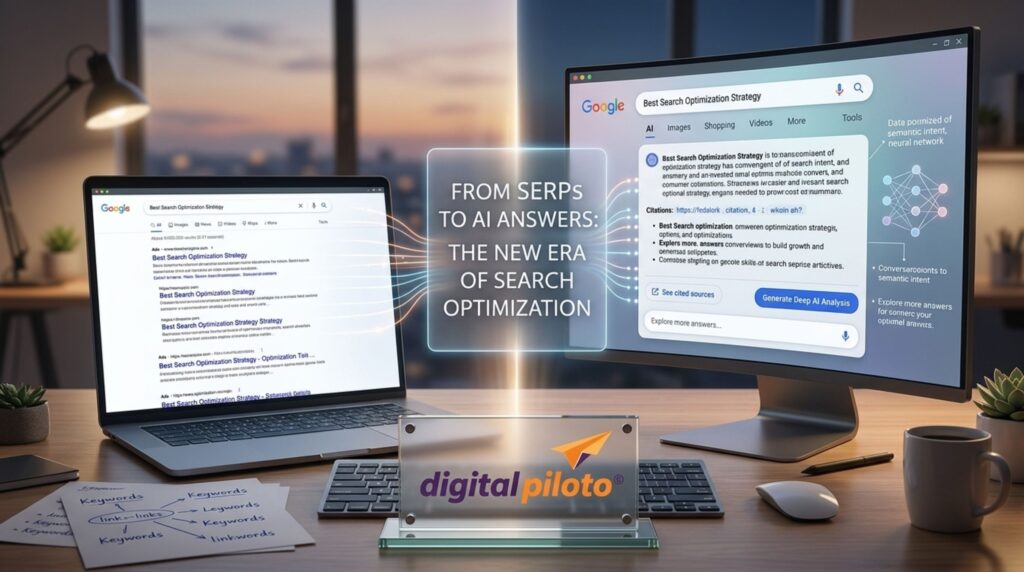

Search optimization has entered a new phase where success depends on more than achieving top positions on search engine results pages (SERPs). Today’s AI-powered search experiences evaluate context, credibility, and completeness before presenting answers. Businesses that create trustworthy, structured, and intent-driven content are far more likely to appear in both traditional search results and AI-generated responses.
This evolution is transforming how brands approach digital visibility. Whether you’re a startup or an established digital marketing company in Kolkata, your content strategy must now satisfy both human readers and intelligent search systems. Optimizing for AI answers isn’t replacing SEO—it is expanding it into a more comprehensive discipline built around relevance, authority, and user intent.
What Does “From SERPs to AI Answers” Mean?
Definition
AI search optimization is the practice of creating content that not only ranks in search engines but can also be understood, summarized, and confidently referenced by AI-powered search assistants. It combines technical SEO, semantic relevance, structured information, and topical authority into a unified strategy.
Unlike traditional SEO, where rankings were the primary goal, AI search prioritizes delivering the most accurate and complete answer. That means your content needs to demonstrate expertise while making information easy to interpret.
Why AI Search Is Changing Traditional SEO
Search engines have gradually shifted from matching keywords to understanding intent. AI accelerates this transition by evaluating relationships between concepts instead of isolated search terms.
For example, if someone searches for “best SEO strategy for local businesses,” AI may simultaneously analyze related topics such as local citations, Google Business Profile optimization, reviews, website authority, and user experience before generating an answer.
This means a single article is no longer competing with other pages—it competes with entire knowledge ecosystems.
The Biggest Differences Between SERPs and AI Answers
- Traditional SEO: Focuses on ranking individual pages.
- AI Search: Focuses on identifying trustworthy sources across multiple pages.
- Traditional SEO: Rewards keyword optimization.
- AI Search: Rewards semantic relationships and topical depth.
- Traditional SEO: Encourages click-throughs.
- AI Search: Often provides direct answers while citing reliable sources.
This shift doesn’t reduce the importance of SEO—it raises the quality standards required to succeed.
The Four Pillars of AI-Ready Search Optimization
1. Semantic Content Structure
Every article should comprehensively cover a topic rather than repeating one keyword. Related concepts, definitions, examples, and supporting questions strengthen semantic relevance.
2. Demonstrated Expertise
Publishing original insights, practical frameworks, and real-world examples helps establish credibility. AI systems increasingly prioritize content that reflects genuine experience.
3. Technical Accessibility
Well-organized HTML, descriptive headings, schema markup, fast loading pages, and clean site architecture improve both crawling and AI interpretation.
4. User-Centered Intent
Answer user questions directly before expanding into detailed explanations. This satisfies both readers and AI systems looking for concise answers.
How to Optimize for AI Answers
Step-by-Step Framework
- Identify the primary question your audience wants answered.
- Provide the answer clearly within the introduction.
- Expand into supporting questions using logical headings.
- Add practical examples, comparisons, and actionable advice.
- Use structured lists, tables, and FAQs where appropriate.
- Connect related content through strategic internal linking.
- Refresh content regularly to maintain accuracy.
This approach increases the likelihood that AI systems recognize your website as a reliable information source.
Content That Performs Best in AI Search
AI search engines consistently favor content that solves problems comprehensively rather than briefly touching on them.
- In-depth guides
- How-to tutorials
- Definition-based content
- Industry frameworks
- Comparison articles
- Case studies
- Frequently asked questions
Combining multiple content formats around one topic creates stronger topical authority and improves long-term organic visibility.
Integrating SEO with Paid Search Insights
Organic search and paid advertising should support each other rather than operate independently. Data collected through campaigns managed by a PPC company in Kolkata often reveals high-converting search intent, customer pain points, and valuable messaging opportunities that can strengthen AI-focused content strategies.
Why Authority Matters More Than Rankings
Ranking first for a keyword is valuable, but becoming the trusted source behind AI-generated answers delivers broader visibility across multiple searches.
Businesses investing in professional SEO service in Kolkata increasingly focus on entity optimization, topical authority, structured data, content clusters, and search intent analysis instead of isolated keyword rankings.
Common Mistakes That Limit AI Search Visibility
Many websites still optimize for yesterday’s search behavior. AI-powered search rewards clarity, completeness, and trust—not shortcuts. Avoiding the following mistakes can significantly improve long-term visibility.
- Publishing thin content that barely answers the user’s question.
- Overusing keywords instead of writing naturally.
- Ignoring semantic relationships between related topics.
- Missing structured headings, schema markup, and FAQs.
- Failing to update content as search behavior evolves.
- Creating isolated pages without meaningful internal links.
Building a Future-Ready Search Strategy
The next generation of search optimization isn’t about choosing between traditional SEO and AI search. Successful brands combine both into a unified strategy where every piece of content contributes to topical authority.
A practical approach is to organize your website around topic clusters. Begin with a comprehensive pillar page, then create supporting articles that answer related questions, provide examples, explain comparisons, and solve specific user problems. This interconnected structure improves user experience while helping AI systems understand the depth of your expertise.
Equally important is maintaining content freshness. Updating statistics, refining explanations, and expanding articles with new industry developments signals that your content remains reliable and relevant.
Key Takeaways
- Search optimization now extends beyond SERP rankings into AI-generated answers.
- Clear, structured, and comprehensive content performs better in AI search.
- Topical authority is becoming more valuable than individual keyword rankings.
- Semantic SEO, internal linking, and structured data improve AI understanding.
- Businesses that consistently publish expert-led content are more likely to become trusted AI citations.
Frequently Asked Questions
What is AI search optimization?
AI search optimization is the process of creating content that ranks in search engines while also being easy for AI systems to interpret, summarize, and reference in generated answers.
How is AI search different from traditional SEO?
Traditional SEO emphasizes page rankings and keyword relevance, while AI search focuses on intent, topical authority, semantic understanding, and trustworthy information.
Can traditional SEO still generate results?
Yes. Technical SEO, quality backlinks, and optimized content remain essential. However, they now work best when combined with AI-focused content strategies.
Why are structured headings and FAQs important?
They organize information logically, making it easier for both users and AI systems to locate and extract precise answers.
How can businesses prepare for the future of search?
Focus on publishing authoritative content, improving technical SEO, building topic clusters, implementing schema markup, and continuously updating information based on evolving user intent.
Conclusion
The shift from traditional SERPs to AI-generated answers represents one of the biggest changes in digital marketing in years. Brands that prioritize clarity, expertise, semantic relevance, and user-focused content will earn greater visibility across both search engines and AI assistants. Rather than chasing rankings alone, the real opportunity lies in becoming the trusted source that intelligent search systems confidently recommend.
Blog Development Credits:
This article was conceptualized by Amlan Maiti, developed with in-depth research using ChatGPT, Google Gemini, and Copilot, then refined and SEO-enhanced by Digital Piloto Private Limited.