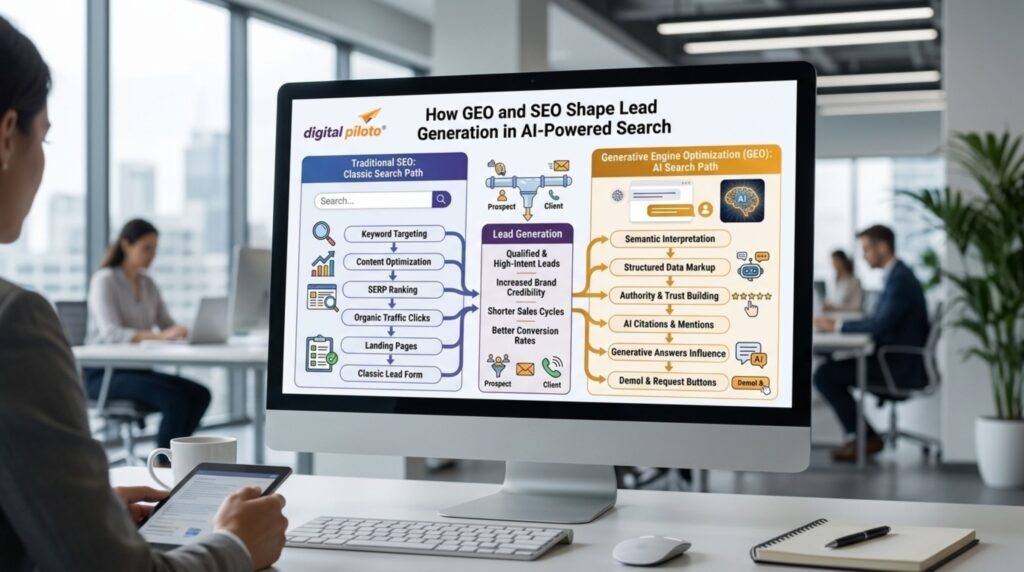

Lead generation used to begin with a search, a click, and a landing page. AI-powered search is changing that sequence. Prospects can now ask complex questions, compare providers, evaluate solutions, and form opinions before visiting a website. For brands, the challenge is no longer just earning rankings. It is earning consideration early enough to influence the eventual buying decision.
That is why modern digital marketing agency strategies increasingly bring SEO and GEO together. SEO helps a business remain discoverable across traditional search, while GEO focuses on visibility within generative search experiences. Used properly, the two can create a broader path from discovery to qualified lead.
The Search Funnel Is Becoming Less Linear
There was a time when the buyer journey looked relatively predictable: search for a service, scan the results, visit a website, read a few pages, and submit a form.
Today, a prospect might do something very different.
They could ask ChatGPT for suitable vendors. Then they might use Google AI Mode to compare approaches. A few minutes later, they may check reviews, ask a follow-up question about pricing, and only visit two or three websites after an initial shortlist has already formed.
The website is no longer necessarily the first destination.
It may be the place where a decision already influenced elsewhere gets validated.
Recent research illustrates how quickly this behavior is developing. McKinsey reported in 2026 that 63% of surveyed European consumers used AI tools to compare options such as brands, models, prices, and reviews, while 55% used AI to learn about a product or category. Another 46% used AI for discovery or inspiration. McKinsey’s 2026 consumer research provides the survey data.
For lead generation, the implication is straightforward: brands need visibility before the prospect reaches the conventional conversion page.
SEO and GEO Do Different Jobs
SEO and GEO are often presented as competing disciplines. They are better understood as two layers of the same visibility system.
SEO builds discoverability
Traditional SEO helps search engines crawl, interpret, index, and rank useful pages. It deals with technical accessibility, content quality, internal linking, search intent, authority, site structure, and many other signals.
These fundamentals remain relevant to AI-powered search. In its current guidance, Google explicitly says that SEO best practices continue to matter because its generative AI search features rely on core Search ranking and quality systems. Google’s guide to optimizing for generative AI features also emphasizes unique, useful, non-commodity content rather than special “AI hacks.”
GEO expands the discovery surface
Generative Engine Optimization focuses on how a brand’s information can be discovered, interpreted, referenced, and represented in AI-generated answers.
That means thinking beyond one webpage.
What does the wider web say about the company? Are its services clearly described? Are its products and expertise easy to understand? Do credible third-party sources reinforce its claims? Are important questions answered somewhere authoritative?
GEO therefore adds a broader visibility layer to an existing SEO strategy.
Why AI Search Matters for Lead Generation
AI search is particularly relevant to lead generation because it can influence prospects during the research stage, before they show obvious buying intent on a company’s own website.
McKinsey’s 2026 US consumer research found that 68% of respondents had used at least one AI tool during the previous three months. Among AI users, 19% reported using AI to discover or decide on brands, products, or services. More importantly for consideration-stage marketing, 62% of AI-enabled shoppers used AI to compare options and 55% used it to learn about a category or product. McKinsey’s 2026 consumer research provides the underlying figures.
Notice where much of that activity occurs: before the purchase.
That is precisely where lead-generation strategies need influence.
If an AI system helps a prospect decide which three companies are worth investigating, a brand missing from that conversation may never receive the opportunity to compete for the lead.
From Ranking for Keywords to Answering Decisions
Traditional SEO often starts with keyword research. That remains useful, but AI-powered search makes another question increasingly important:
What decision is the prospect trying to make?
Suppose a business searches for “B2B SEO services.” That phrase reveals something. But a conversational follow-up might be:
“What should a SaaS company look for when choosing an SEO partner that understands international expansion and AI search?”
The second query contains far more commercial context.
A strong lead-generation strategy should therefore build content around the decisions behind the keywords.
- Problem questions: Why is organic traffic falling? Why are rankings not producing leads?
- Evaluation questions: Which SEO approach fits a B2B company, ecommerce brand, or startup?
- Comparison questions: How do SEO, paid search, GEO, and content marketing differ?
- Risk questions: What should a company avoid when outsourcing search optimization?
- Decision questions: What should a buyer evaluate before selecting an agency or platform?
These questions create content that can attract people earlier in the buying journey and help them move toward a meaningful action.
GEO Can Influence the Shortlist
This is where generative AI SEO agency strategies become particularly relevant.
Imagine a prospect asking an AI assistant:
“Which digital marketing companies can help an Indian ecommerce business improve organic visibility and AI-search discovery?”
The prospect may never have heard of your company.
They are not searching for your brand name. They are searching for a solution.
That creates what might be called category-level lead generation. The brand becomes visible because its expertise is connected with the problem, rather than because the prospect already knows the company exists.
This is a major difference between branded and non-branded discovery.
Traditional SEO has worked toward this for years through category and problem-based queries. GEO extends the same idea into conversational environments where the system may summarize several sources before presenting recommendations or options.
Content Has to Earn Its Place
There is a temptation to respond to AI search by publishing more content. More articles. More FAQs. More landing pages. More variations of the same keyword.
That can quickly become counterproductive.
Google’s current AI-search guidance specifically emphasizes unique, non-commodity content and warns against approaches that create large amounts of low-value material. Google’s spam policies also apply to attempts to manipulate generative AI responses. Google Search’s spam-policy documentation makes this explicit.
For lead generation, the better approach is to create content that actually helps someone make progress.
That could include:
- Original research: proprietary observations, surveys, datasets, or industry analysis.
- Decision guides: practical explanations of how buyers should evaluate options.
- Detailed case studies: clear descriptions of problems, approaches, limitations, and outcomes.
- Expert content: genuine perspectives from people with relevant experience.
- Product and service documentation: transparent information that removes uncertainty.
This kind of content can support both SEO and GEO because it provides substance rather than simply repeating terminology.
Trust Is Part of the Conversion Path
Visibility alone does not generate leads.
Trust does.
A prospect might encounter a company through an AI-generated answer, but the next question is often, “Can I believe this company?”
That is where third-party signals, customer experiences, author expertise, reviews, transparent service information, and consistent brand information become important.
Interestingly, AI adoption does not automatically mean blind AI trust. McKinsey’s 2026 European research found that 56% of respondents were comfortable with AI suggesting options when humans retained the final decision, while only 41% trusted generative AI to summarize reviews and highlight trade-offs. The McKinsey study shows that people may welcome AI assistance while still wanting control and credible evidence.
For marketers, this is a useful reminder: the goal is not simply to appear in an AI answer. The information behind that appearance must survive human scrutiny.
SEO Still Owns the Technical Foundation
GEO cannot compensate for a broken website.
If important pages cannot be crawled, indexed, understood, or connected properly, there is little reason to expect a generative search strategy to perform consistently.
A modern lead-generation website should therefore pay attention to:
- Crawlability and indexation
- Clear internal linking
- Fast and usable mobile experiences
- Descriptive page titles and headings
- Accessible textual information
- Accurate structured data where appropriate
- Clear service, product, company, and contact information
- Strong conversion paths from informational content to commercial pages
Google’s documentation says AI Overviews and AI Mode do not require a separate set of technical requirements beyond normal Search eligibility. Standard SEO fundamentals remain the foundation. Google’s AI features guidance explains the relationship between conventional Search and generative experiences.
In other words, a good SEO service Kolkata strategy is not becoming obsolete. It is becoming part of a wider search-and-discovery framework.
Build a Lead Funnel for AI-Assisted Discovery
The traditional funnel often begins with traffic. The AI-era funnel should begin with influence.
A practical model looks like this:
- Discovery: the prospect encounters your expertise through search, AI answers, publications, communities, or recommendations.
- Understanding: educational content explains the problem and possible solutions.
- Evaluation: comparison pages, guides, case studies, and product information reduce uncertainty.
- Validation: reviews, evidence, credentials, expert profiles, and third-party references reinforce credibility.
- Conversion: a clear CTA moves the qualified prospect toward a consultation, demo, enquiry, trial, or purchase.
This model also changes how content should be internally linked.
A high-level educational article should not be a dead end. It should naturally lead to deeper guides, relevant service pages, proof, and eventually a commercial action.
The journey should feel like a conversation rather than a maze.
Measure Leads, Not Just Visibility
One of the biggest mistakes businesses can make with GEO is creating a new visibility metric and forgetting the original business objective.
Leads still matter.
Revenue still matters.
Qualified conversations still matter.
AI visibility becomes valuable when it contributes to those outcomes.
Businesses can therefore monitor a broader measurement set:
- Organic rankings and impressions
- AI-search visibility for important commercial questions
- Branded search growth
- AI referral traffic where identifiable
- Engagement with decision-stage content
- Assisted conversions
- Marketing-qualified and sales-qualified leads
- Pipeline or revenue influenced by organic and AI discovery
Google also provides Search Console reporting for generative AI features, allowing site owners to examine performance associated with those experiences. The important point is to connect that visibility data back to actual business outcomes rather than treating impressions as the finish line.
Why SEO and GEO Work Better Together
There is a useful division of labor here.
SEO makes the website discoverable, crawlable, understandable, and competitive.
GEO broadens the strategy toward AI-mediated discovery, contextual relevance, citations, recommendations, and conversational decision journeys.
Neither should operate in isolation.
A company with excellent technical SEO but weak brand information may struggle to influence AI recommendations. A company with impressive GEO experiments but poor technical foundations may struggle to maintain reliable organic visibility.
The strongest approach is integrated.
Build the technical foundation. Create genuinely useful content. Establish clear entities and expertise. Answer commercial questions. Strengthen third-party credibility. Connect content to conversion paths. Then measure what actually contributes to pipeline.
The Future of AI-Powered Lead Generation
The direction of travel is becoming clearer: AI is moving earlier into the customer journey.
McKinsey’s 2026 marketing research describes a shift from an attention-focused model toward a trust-focused environment in which recommendation systems increasingly influence which brands consumers consider. The research also emphasizes the importance of machine-readable credibility signals, detailed information, verified reviews, expert input, and continuously updated content. McKinsey’s 2026 analysis of AI and marketing explores this transition.
That does not mean every lead will come through an AI assistant.
Far from it.
People will continue to use Google, websites, referrals, social platforms, review sites, communities, email, and direct conversations. AI simply adds another influential layer to an already fragmented journey.
The brands that adapt well will not abandon the fundamentals. They will connect them.
Frequently Asked Questions
What is the difference between SEO and GEO?
SEO focuses on improving visibility and discoverability across search engines using technical, content, authority, and relevance signals. GEO focuses more specifically on visibility within generative and AI-mediated search experiences. In practice, the two work best together.
Can GEO directly generate leads?
GEO can contribute to lead generation by helping a brand become visible during AI-assisted research, comparison, and recommendation journeys. Actual lead generation still depends on relevance, trust, offer quality, website experience, and the conversion path.
Does traditional SEO still matter for AI search?
Yes. Google states that SEO best practices remain relevant to its generative AI search experiences because they rely on core Search ranking and quality systems. Technical accessibility, useful content, internal linking, and other SEO fundamentals continue to matter.
How should businesses measure GEO for lead generation?
Businesses should combine AI-search visibility with conventional metrics such as organic traffic, branded searches, conversions, qualified leads, assisted conversions, and revenue influence. The goal is to connect AI discovery with measurable business outcomes.
Final Thoughts
AI-powered search is changing where decisions begin, but it does not change what makes a lead valuable. People still need useful answers, credible information, a compelling solution, and a reason to take the next step.
SEO helps brands remain discoverable. GEO helps them participate in the new layer of AI-mediated discovery. Together, they can turn search visibility into something more meaningful: a sustained opportunity to influence the buyer before the click, earn trust during evaluation, and convert attention into qualified demand.
The future of lead generation is therefore not SEO versus GEO. It is a smarter combination of both.
Blog Development Credits
This article was conceptualized by Amlan Maiti, researched with AI-assisted tools, and finally refined for SEO by Digital Piloto Private Limited.