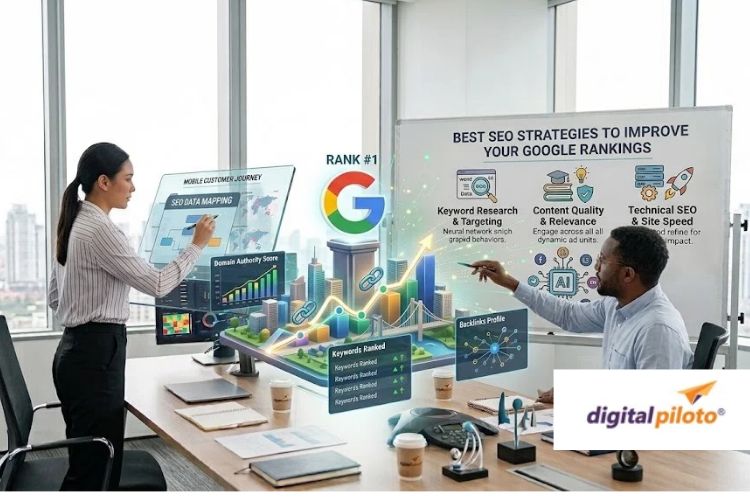

What Is SEO and Why Does It Matter?
Search engine optimisation (SEO) is the process of improving a website so search engines can understand its content and users can find relevant information through organic search results.
SEO includes several connected activities, such as keyword research, content development, technical optimisation, internal linking, website usability, and earning relevant backlinks. These activities help search engines discover pages and assess how well they address a searcher’s needs.
For businesses, SEO can support brand awareness, qualified website traffic, enquiries, and sales. It is not an instant solution, and no legitimate SEO provider can guarantee a specific Google position. Results depend on competition, website quality, search intent, and many other factors.
12 Best SEO Strategies to Improve Your Google Rankings
1. Understand Search Intent Before Targeting Keywords
Keyword research is more effective when it begins with understanding what searchers actually want. Someone searching for “what is technical SEO” is looking for an explanation, while someone searching for “SEO services for small businesses” may be comparing providers.
Identify whether your audience is seeking information, comparing options, looking for a specific website, or preparing to make a purchase. Then create a page that matches that purpose.
- Use keyword research tools to discover relevant search terms.
- Review search results to understand the content formats that satisfy the query.
- Group closely related keywords by topic and intent.
- Map important keywords to suitable existing or new pages.
Avoid creating multiple pages that target the same intent without a clear reason. A well-planned site structure helps users navigate your content and reduces unnecessary duplication.
2. Publish Helpful, Original, People-First Content
Content should solve a genuine problem, answer a question, or help readers make an informed decision. Instead of rewriting information already available online, provide meaningful explanations, examples, original insights, practical steps, or relevant experience.
Organise articles with descriptive headings, short paragraphs, lists where useful, and clear explanations of technical concepts. Support factual claims with trustworthy sources and keep important information updated when circumstances change.
Google recommends prioritising helpful, reliable, people-first content rather than producing pages primarily to manipulate rankings. Focus on the value a reader receives, not on reaching an arbitrary word count.
For stronger results, build content around related topics. A website discussing SEO, for example, could cover keyword research, on-page optimisation, technical audits, content strategy, and performance measurement in connected articles.
3. Optimise Title Tags and Meta Descriptions
Your page title helps users and search engines understand the main topic of a webpage. A clear, relevant title can also help users decide whether a result matches their needs.
Write a unique title for each important page, place the main topic naturally, and avoid repetitive keyword stuffing. Meta descriptions should summarise the page accurately and explain what a visitor can expect to learn or do.
Remember that Google may generate title links and search snippets differently from the text you provide. Well-written metadata helps communicate relevance, but it does not guarantee that Google will display the exact wording or that a page will rank higher.
4. Improve On-Page SEO Elements
On-page SEO helps search engines and readers understand the subject and structure of each page. Begin with a descriptive main heading, a logical heading hierarchy, useful body content, and clear navigation.
Use the primary keyphrase naturally where it makes sense, including in the page title, main heading, introduction, and relevant subheadings. Include related terms when they help explain the topic rather than forcing them into every section.
Optimise images with descriptive file names and meaningful alternative text when appropriate. Use concise, descriptive URLs and ensure that important information is available in accessible page content.
5. Strengthen Internal Linking
Internal links connect pages within your website. They help visitors discover related information and provide search engines with paths to crawl your content.
Link from relevant blog posts to related service pages, and connect supporting articles to broader topic guides. Use descriptive anchor text that tells readers what they can expect from the destination page.
For example, a business targeting customers in Durgapur may connect relevant educational content to its SEO Service Provider in Durgapur page when the link genuinely helps readers explore local SEO services.
Prioritise useful context over adding links simply to increase their number. Check for broken links and ensure important pages are not difficult to reach through the site’s navigation or internal linking structure.
6. Improve Website Speed and Page Experience
A website should load efficiently and remain easy to use across mobile phones, tablets, and desktop computers. Slow pages, intrusive pop-ups, broken layouts, and confusing navigation can frustrate visitors.
Practical improvements include compressing images, reducing unnecessary scripts, enabling suitable caching, choosing reliable hosting, and reviewing third-party tools that slow down pages.
Use Google’s Core Web Vitals as part of your performance assessment. They measure loading performance, responsiveness, and visual stability. Tools such as PageSpeed Insights and Google Search Console can help identify areas that need attention.
Page experience is only one part of SEO. A fast website still needs relevant, helpful content and a strong overall user experience to compete effectively in search results.
7. Make Your Website Mobile-Friendly
People increasingly use mobile devices to research businesses, compare products, and contact service providers. Your website should provide a consistent experience regardless of screen size.
Use responsive design, readable text, accessible navigation, appropriately sized buttons, and forms that are easy to complete on smaller screens. Check whether essential content and internal links are available on mobile versions of your pages.
Test important journeys, such as requesting a quote or completing a purchase, on real devices. A mobile-friendly experience can make it easier for visitors to engage with your business after discovering it through search.
8. Invest in Local SEO
Local SEO helps businesses become more visible to people searching for services in a particular area. It is especially useful for companies that serve customers within specific cities or neighbourhoods.
Keep your Google Business Profile accurate where eligible, including your business details, service categories, contact information, opening hours, and service areas. Encourage genuine customer reviews and respond professionally to feedback.
Create location-specific landing pages when they provide useful, distinct information about the services available in each area. Avoid producing near-identical city pages that offer little value beyond changing the place name.
For businesses serving Durgapur and nearby markets, a coordinated approach to SEO and wider Digital Marketing Service Provider in Durgapur support can connect organic search visibility with broader customer acquisition activities.
9. Earn Relevant, High-Quality Backlinks
Backlinks are links from other websites to your website. Relevant links can help people discover your content and may contribute to how search engines assess your site’s prominence and relevance.
Focus on earning links through useful resources, original research, expert contributions, genuine partnerships, and content that others naturally want to reference.
Avoid buying links intended to manipulate rankings, participating in link schemes, or using automated methods to create large numbers of low-quality backlinks. These approaches can create search policy risks.
Review your backlink profile periodically, but remember that a large backlink count alone does not demonstrate quality. Relevance, context, and the credibility of referring sources matter when evaluating link opportunities.
10. Use Structured Data Where Appropriate
Structured data provides search engines with additional information about the content of a page. Depending on the page and supported search features, eligible markup may help Google interpret details about products, articles, organisations, events, or other entities.
Choose a schema type that accurately represents the visible content. Follow the relevant documentation, validate the markup, and keep structured data consistent with what users can actually see on the page.
Structured data does not guarantee enhanced search appearances or higher rankings. Use it to describe content accurately rather than to make unsupported claims or mark up information that is not present.
11. Prepare Content for AI-Powered Search Experiences
People discover information through traditional search results as well as AI-powered search and answer experiences. Clear, well-organised content can help readers understand your expertise and find relevant answers across these discovery channels.
Answer important questions directly, explain concepts in context, cite trustworthy sources where appropriate, and maintain accurate information about your business and services. Demonstrate real experience and provide original value rather than publishing generic pages that repeat existing material.
Businesses exploring this area can learn about a generative engine optimization specialist approach as part of a wider search visibility strategy.
AI search optimisation does not guarantee inclusion in generated answers. Strong fundamentals—helpful content, accessible pages, clear business information, and a trustworthy website—remain important.
12. Measure SEO Performance and Improve Continuously
SEO requires regular measurement because rankings, user behaviour, competitors, and search results can change over time. Use Google Search Console to review search impressions, clicks, queries, indexing issues, and page performance. Web analytics can help you understand what visitors do after reaching your website.
Track metrics that relate to your business objectives, such as:
- Organic clicks and relevant search impressions.
- Performance of important keywords and landing pages.
- Qualified leads, enquiries, and organic sales.
- Engagement and conversion rates on key pages.
- Technical errors and indexing problems.
When traffic falls, investigate which pages and queries were affected before making major changes. Compare date ranges, review recent site updates, and distinguish between ranking changes, seasonality, and technical issues.
Common SEO Mistakes to Avoid
Even a well-planned SEO campaign can struggle when the website relies on outdated or manipulative practices. Avoid these common mistakes:
- Keyword stuffing: Repeating phrases unnaturally makes content harder to read.
- Duplicate or thin content: Pages that add little unique value may not satisfy searchers.
- Buying manipulative backlinks: Link schemes can violate Google’s spam policies.
- Ignoring technical issues: Broken links, accidental indexing restrictions, and inaccessible pages can interfere with discovery.
- Neglecting mobile usability: A difficult mobile experience can discourage visitors from taking action.
- Expecting immediate results: Search performance often takes time to reflect meaningful improvements.
- Chasing rankings without business goals: Traffic is more valuable when it reaches the right audience and supports useful outcomes.
Frequently Asked Questions
1. What is the most effective SEO strategy?
There is no single strategy that works for every website. A strong approach combines useful content, search intent research, on-page optimisation, technical accessibility, relevant internal links, and ongoing performance analysis.
2. How long does it take to improve Google rankings?
SEO results vary by website, competition, technical condition, content quality, and the changes made. Some improvements may be noticed relatively quickly, while others can take several months or longer. No provider can guarantee a specific timeline or ranking.
3. Are backlinks still important for SEO?
Backlinks can help people discover content and provide signals of relevance and prominence. Focus on earning relevant, editorially justified links rather than pursuing large numbers of low-quality links.
4. Does publishing more blog posts guarantee better rankings?
No. Publishing more content does not automatically improve rankings. Each page should serve a clear purpose, address a real audience need, and provide value that justifies its existence.
5. How can I track my website’s SEO performance?
Use Google Search Console to monitor search visibility, clicks, queries, and indexing, and use web analytics to assess traffic quality, enquiries, and conversions. Review these measures regularly and connect them to your business goals.
Final Thoughts
Improving Google rankings is an ongoing process built around relevance, usefulness, technical quality, and trust. Start by understanding your audience, improving important pages, fixing barriers to crawling and usability, and measuring the results of your work.
Rather than chasing shortcuts or guaranteed positions, focus on creating a website that answers customers’ questions and makes it easy for them to take the next step. With consistent improvements and a clear strategy, your business can build a stronger foundation for organic search visibility.
Author: Amlan Maiti, Founder & Director at Digital Piloto Pvt. Ltd. — LinkedIn Profile
SEO Credits: Digital Piloto SEO, GEO & Digital Marketing Team