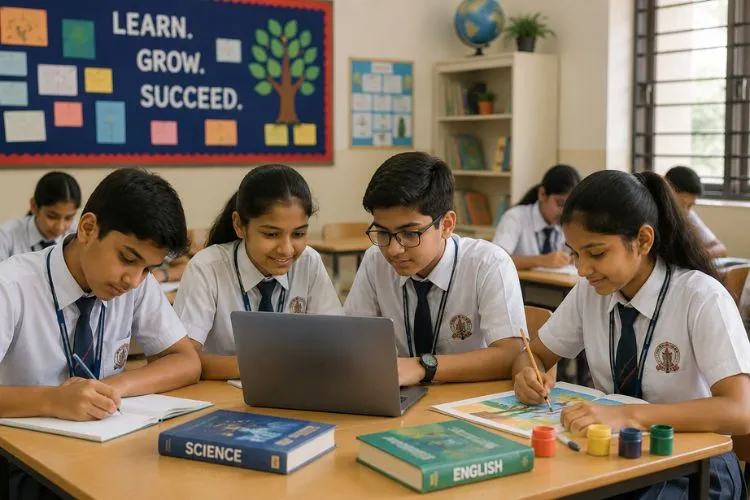

What makes a school truly valuable for a growing child? It is rarely just exam scores. A strong education should build knowledge, curiosity, confidence, creativity, and good judgment together. That is where a balanced approach becomes important. For families exploring ICSE Schools in Kolkata, the emphasis on academics alongside wider development can be especially meaningful.
Education Should Go Beyond the Textbook
Children do not learn in exactly the same way. One may enjoy mathematics, another may naturally gravitate towards literature, while someone else may discover their confidence on a sports field or an art stage. A balanced school recognises these differences instead of treating education as a race based only on marks.
The ICSE framework provides room for this wider perspective. The current CISCE regulations include areas such as art, physical education, community service, moral and spiritual values, and a third language alongside academic subjects. Many subjects also include internal assessment, creating space for learning that is not limited to a final written examination. CISCE ICSE Regulations
- Academic foundation: Strong subject knowledge supports future study and informed decision-making.
- Practical development: Projects, activities, and application-based learning can make lessons more memorable.
- Personal growth: Communication, collaboration, discipline, and confidence matter well beyond school.
Why Holistic Learning Creates Stronger Learners
Imagine a student who can solve a difficult equation but struggles to explain an idea, work with classmates, or handle a setback. Academic ability alone does not tell the whole story. Education becomes more powerful when children are given opportunities to practise different kinds of skills.
This is one reason holistic education has become increasingly relevant. India’s UDISE+ 2023–24 data recorded more than 248 million enrolments from pre-primary through higher secondary education, highlighting the enormous scale of the school system and the importance of creating learning environments that serve children in varied ways. Ministry of Education UDISE+ Report
Learning Through Different Experiences
A well-rounded school experience might involve classroom discussions, laboratory work, creative activities, sports, presentations, reading, community-oriented projects, and technology-supported lessons. These experiences give students different ways to understand concepts and express what they know.
For younger children, this balance begins even earlier. A thoughtfully designed Nursery School experience can help develop language, social interaction, movement, curiosity, and early problem-solving skills without making learning unnecessarily stressful.
What Parents Should Look for in a Balanced School
Choosing a school is personal. A glossy campus or a long list of activities should not be the only deciding factor. Parents can look more closely at how learning actually happens from day to day.
- Look beyond marks: Ask how the school supports creativity, communication, sports, arts, and independent thinking.
- Examine classroom practices: Find out whether students get opportunities to discuss, question, experiment, and apply concepts.
- Understand assessment: A healthy balance should recognise continuous effort and practical understanding alongside examinations.
- Consider student wellbeing: Children learn better when expectations are clear but the environment remains supportive and encouraging.
Building Confidence Alongside Academic Skills
One of the quiet benefits of balanced education is confidence. A child who presents a project, performs in a school activity, plays a team sport, or participates in a discussion learns something that a textbook cannot fully teach: how to prepare, make mistakes, respond to feedback, and try again.
These experiences can also make the transition between stages of education smoother. Families planning Class 1 Admission in Kolkata may therefore want to consider not only the syllabus but also the school’s approach to communication, independence, classroom participation, and overall student development.
How Schools Can Make Learning More Meaningful
A balanced approach does not mean giving every activity equal time. It means understanding what students need at different stages and creating sensible connections between academic learning and real life.
- Connect lessons with everyday situations and current experiences.
- Encourage students to ask questions instead of simply memorising answers.
- Use projects and collaborative tasks to develop practical and social skills.
- Give students opportunities to explore arts, sports, technology, and community activities.
- Provide constructive feedback that focuses on progress as well as performance.
Frequently Asked Questions
What does balanced learning mean in an ICSE school?
Balanced learning combines strong academics with opportunities for creativity, physical activity, communication, practical work, values, and social development.
Does ICSE education focus only on examinations?
No. The ICSE framework includes internal assessment and areas such as art, physical education, community service, and moral and spiritual values alongside core academic subjects.
Why is holistic education important for children?
Holistic education helps children develop different abilities together, including knowledge, communication, confidence, creativity, collaboration, and problem-solving.
What should parents consider when choosing an ICSE school?
Parents should consider teaching quality, curriculum, assessment methods, student support, extracurricular opportunities, school culture, and how effectively the school encourages independent learning.
Final Thoughts
The best school experience is not simply about filling a child’s mind with information. It is about helping that child become curious, capable, confident, and considerate. ICSE schools that balance academic rigour with creativity, practical experiences, physical activity, and personal development can give students a stronger foundation for both examinations and life beyond the classroom.