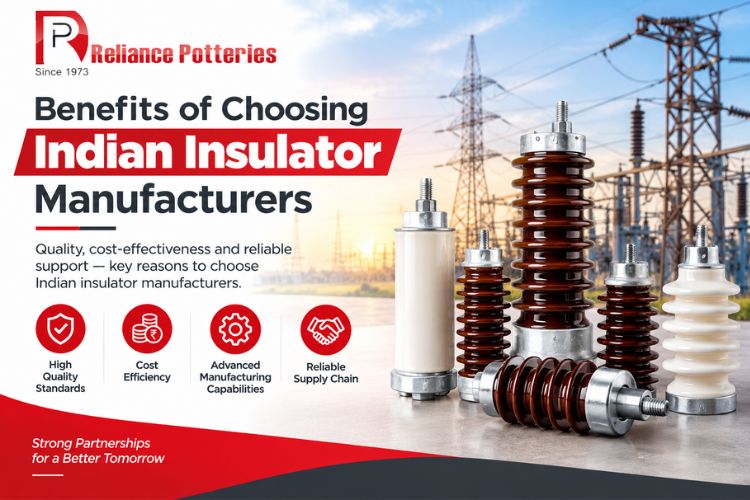

Choosing the right electrical insulator manufacturer affects product reliability, procurement efficiency and long-term operating costs. For power utilities, electrical equipment manufacturers, EPC contractors and industrial plants, sourcing from India can offer practical advantages, including easier technical coordination, opportunities for customisation and access to domestic manufacturing expertise. The benefits, however, depend on the supplier’s capabilities and the product’s application.
Also Read: How Insulator Design Influences Electrical Equipment Reliability
Why Consider Insulators Manufacturers in India?
India has an established electrical manufacturing sector serving power transmission, distribution, substations, transformers and industrial equipment. The Ministry of Power reported that 35,172 circuit kilometres of transmission lines were added during FY 2023–24 to FY 2025–26, reflecting continuing investment in the country’s power infrastructure.
For buyers evaluating Insulators Manufacturers in India, the key question is not simply where a product is made. It is whether the manufacturer can meet the project’s electrical, mechanical, environmental and documentation requirements.
1. Easier Technical Communication and Coordination
Electrical insulators are application-specific components. Their selection may depend on operating voltage, mechanical loading, creepage distance, mounting dimensions, temperature and environmental exposure.
Working directly with an Indian manufacturer can make it easier to discuss drawings, clarify specifications and coordinate modifications. This can be particularly helpful when a project requires a non-standard shape, specialised mounting arrangement or a component designed to fit existing equipment.
However, communication benefits should be assessed in practice. Buyers should confirm who will handle technical queries, review drawings and approve changes before production begins.
2. Scope for Customised Manufacturing
A standard product may not suit every installation. Transformer assemblies, switchgear and electrostatic precipitators can require different dimensions, materials, fittings and performance characteristics.
A technically capable manufacturer may be able to adapt a product to the buyer’s approved specifications. Reliance Potteries, for example, lists specialised electro-porcelain products alongside its broader insulator range and describes custom manufacturing capabilities on its company website.
For industrial pollution-control systems, buyers can explore Manufacturers of Cylindrical Support Insulators for ESP to review a product relevant to electrostatic precipitator applications.
Customisation should always be supported by approved drawings, defined tolerances, agreed testing criteria and written confirmation of the final specification.
3. Better Opportunities for Quality Coordination
Quality assurance is one of the most important factors when selecting an electrical insulator supplier. A competitive quotation is not enough; buyers need evidence that the product meets the specified requirements.
Before placing an order, review the manufacturer’s quality-control processes and ask for documentation relevant to the particular product. Depending on the application and purchase specification, this may include:
- Material specifications and dimensional inspection records.
- Applicable mechanical and electrical test reports.
- Batch identification, inspection records and traceability.
- Inspection and acceptance criteria agreed before production.
BIS publishes Indian Standards and related information through its Know Your Standard portal. Its programme includes IS 731:1971 for porcelain insulators used on overhead power lines above 1,000 V. Buyers must check the applicable current requirements for their specific product rather than assume that one standard covers every insulator.
For international projects, applicable IEC requirements may also be relevant. For example, IEC 60383-1:2023 covers specified ceramic and glass insulators for overhead lines. The correct standard depends on the insulator’s intended use.
4. Potential Savings in Total Procurement Cost
Indian manufacturing may offer a competitive overall procurement proposition, but the lowest quoted price does not automatically represent the best value.
Buyers should calculate the landed and lifecycle cost, considering the purchase price, freight, packaging, duties where applicable, inspection, installation, maintenance and the financial impact of delayed or rejected supplies.
Domestic sourcing may simplify some transport and communication arrangements, particularly for projects located in India. The actual savings depend on the supplier’s location, order size, product complexity and delivery terms. Export buyers must also consider international freight, import duties, customs requirements and destination-country specifications.
A useful approach is to compare like-for-like quotations against the same technical specification and delivery conditions.
5. More Practical Delivery and Supply Coordination
Working with a domestic manufacturer can make order follow-up, document exchange and production coordination more convenient. Buyers may also find it easier to arrange technical meetings or inspection visits when the factory is accessible.
These advantages do not guarantee faster delivery. Manufacturing capacity, raw-material availability, order complexity and production schedules all influence lead times.
Before confirming an order, request a realistic delivery schedule, clarify inspection milestones and agree on packaging and dispatch requirements. For critical projects, also discuss how changes to the design or delivery date will be communicated.
6. Access to Products for Different Electrical Applications
Indian manufacturers serve a variety of electrical and industrial applications, but product specialisation differs from one supplier to another.
Depending on their manufacturing capabilities, suppliers may offer high-tension porcelain insulators, solid-core insulators, transformer bushings, hollow porcelain bushings and specialised ESP components.
The right selection depends on the intended operating conditions. For instance, a component used in switchgear may have different mechanical, electrical and dimensional requirements from an insulator used inside an electrostatic precipitator.
Buyers should therefore evaluate the manufacturer’s relevant product experience instead of assuming that a broad catalogue proves suitability for every project.
How to Choose the Right Indian Insulator Manufacturer
Use the following checklist before making a purchasing decision:
- Verify technical suitability: Confirm voltage rating, mechanical load, creepage distance, dimensions, material and operating environment.
- Check standards and testing: Identify applicable Indian or international standards and request relevant test documentation.
- Assess manufacturing capability: Review the supplier’s product range, process controls and ability to meet the approved drawings.
- Compare total cost: Evaluate price, logistics, inspection, delivery commitments and lifecycle considerations.
- Confirm documentation and support: Agree on drawings, acceptance criteria, traceability, warranties where applicable and technical communication.
No single factor should determine supplier selection. A dependable procurement decision combines verified quality, application suitability, delivery reliability and commercially reasonable terms.
Why Consider Reliance Potteries?
Reliance Potteries is a Kolkata-based manufacturer and exporter of high-tension electro-porcelain insulators. The company states that it began operations in 1973 and supplies products for electrical and industrial applications.
Its publicly listed portfolio includes ESP insulators, porcelain bushings and solid-core insulators. Buyers assessing its suitability should review the product specifications, applicable standards, testing documentation and delivery requirements for their particular project.
Frequently Asked Questions
What are the benefits of choosing Indian insulator manufacturers?
Potential benefits include easier technical coordination, access to domestic manufacturing capabilities, opportunities for customisation and potentially competitive procurement costs. Actual benefits vary by supplier and project.
How can buyers check an electrical insulator manufacturer’s quality?
Ask for applicable standards, product specifications, relevant test reports, inspection criteria and traceability documentation. Verify certification claims against the appropriate official records.
Can Indian manufacturers supply customised porcelain insulators?
Some manufacturers offer customised products. Buyers should confirm whether the supplier can meet their required dimensions, material composition, electrical ratings, mechanical loads and testing criteria.
Are Indian insulators suitable for export projects?
They can be suitable when the products meet the destination project’s applicable specifications and regulatory requirements. Buyers should confirm the required IEC or other relevant standards, documentation and shipping terms before ordering.
Also Read: Trusted Insulator Suppliers for Power Transmission
Conclusion
Choosing an Indian insulator manufacturer can offer advantages in technical coordination, customisation, sourcing flexibility and procurement planning. The value is strongest when the supplier can demonstrate the right manufacturing capability and provide evidence that the product meets the project’s requirements.
Rather than selecting a supplier on price or location alone, compare technical compliance, test documentation, total procurement cost and delivery commitments. To explore relevant electro-porcelain products, visit Reliance Potteries and discuss your project’s specific requirements with the company.
Blog Development Credits:
This article was developed by Reliance Potteries with AI-assisted research and drafting, followed by human review, content refinement, and final SEO optimization by the Reliance Potteries team.