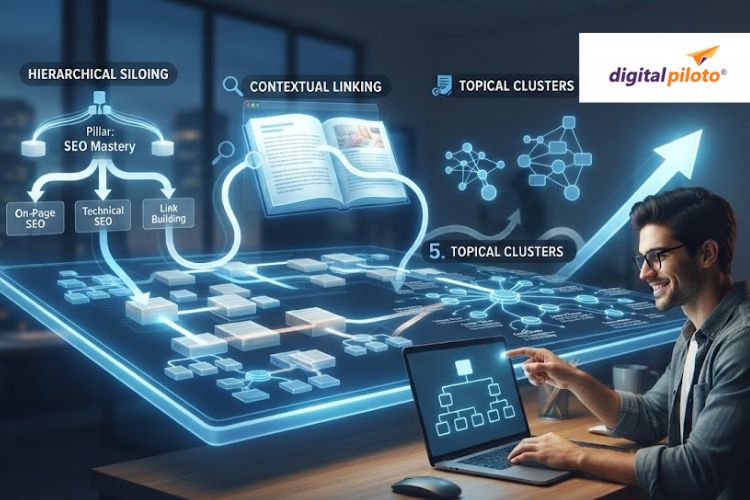

Internal linking improves rankings by helping search engines discover pages, understand topic relationships, and distribute authority across a website. When implemented strategically, internal links strengthen topical relevance, improve user navigation, and increase the visibility of important pages that may otherwise struggle to rank.
Many businesses invest heavily in content creation and backlinks but underestimate the impact of internal architecture. Even experienced teams working with a Digital Marketing Company in Asansol often find that refining internal links produces ranking improvements without creating a single new page.
What Is Internal Linking?
Internal linking is the practice of connecting one page of a website to another page on the same domain through hyperlinks.
These links guide both users and search engine crawlers through your content ecosystem. In simple terms, internal links act like roads connecting important destinations within a city.
Why Does Internal Linking Affect Rankings?
Search engines use internal links to understand which pages matter most and how topics relate to each other.
If an important service page receives links from multiple relevant articles, Google interprets that page as valuable within the website’s hierarchy.
Internal links influence three critical SEO factors:
- Crawlability and page discovery.
- Distribution of link authority.
- Topical context and semantic relationships.
The Difference Between Random Links and Strategic Links
Not all internal links carry equal value.
Randomly linking pages because they contain similar keywords rarely produces meaningful SEO benefits. Strategic links exist because they help users continue their journey naturally.
Weak internal linking example:
Adding a link simply because two pages mention the same phrase.
Strong internal linking example:
Linking a beginner guide on local SEO to advanced content covering citation management, Google Business Profile optimization, and local ranking factors.
Build Topic Clusters Instead of Isolated Articles
One of the most effective modern internal linking strategies involves creating topic clusters.
Definition:
A topic cluster is a collection of related content pieces linked to a central pillar page that covers the broader subject.
For example:
- Pillar Page: Complete Guide to Technical SEO
- Cluster Article: Crawl Budget Optimization
- Cluster Article: XML Sitemap Best Practices
- Cluster Article: Canonical Tag Implementation
- Cluster Article: Mobile SEO Improvements
This structure helps search engines understand topical authority rather than isolated keywords.
Prioritize Links to Revenue Pages
Many websites unintentionally send most of their authority to blog articles while commercial pages receive very little internal support.
Your service pages, product pages, and lead-generation pages should receive links from relevant informational content whenever appropriate.
This approach creates a natural path from education to conversion.
Use Descriptive Anchor Text
Anchor text provides context about the destination page.
Generic phrases such as “click here” or “read more” waste an opportunity to help search engines understand relevance.
Effective anchor text principles:
- Describe the destination accurately.
- Avoid keyword stuffing.
- Use natural language.
- Match user expectations.
The best anchor text often sounds invisible because it fits naturally within the sentence.
Create a Link Depth Strategy
Pages buried deep within a website hierarchy frequently struggle to perform.
As a practical rule, important pages should ideally be reachable within three clicks from the homepage.
Step-by-step process:
- Identify your highest-value pages.
- Measure their click depth.
- Add supporting internal links from related content.
- Monitor crawl frequency and rankings.
- Adjust based on performance data.
Update Older Content With New Links
One of the easiest SEO wins often comes from revisiting older articles.
Every time a new page is published, review previous content and identify opportunities to add contextual links to the new resource.
This habit creates a living content network instead of a collection of disconnected pages.
Use Internal Links to Support AI Search Visibility
AI-powered search systems increasingly analyze relationships between pages rather than individual keywords.
Organizations working with a specialized generative AI seo agency are focusing more on semantic content structures because answer engines reward comprehensive topic coverage and clear content hierarchies.
Strong internal linking helps AI systems understand expertise, authority, and topical breadth more effectively.
Avoid Common Internal Linking Mistakes
The most common mistakes include:
- Using the same anchor text for multiple destinations.
- Creating orphan pages with no incoming links.
- Overloading pages with excessive links.
- Ignoring older content.
- Linking without user value.
Interestingly, excessive internal linking can dilute importance signals just as much as insufficient linking can weaken authority.
Technical Considerations Matter Too
Internal links should be crawlable, accessible, and easy to discover.
Modern website architecture developed by an experienced Web Development Agency in India often integrates SEO-friendly navigation structures directly into the design process rather than treating SEO as an afterthought.
Site architecture and internal linking work best when they are planned together.
Frequently Asked Questions
How many internal links should a page contain?
There is no fixed number. Include as many links as necessary to help users and search engines navigate naturally.
Do internal links pass authority?
Yes. Internal links distribute authority and help search engines identify important pages.
What is an orphan page?
An orphan page is a page with no internal links pointing to it, making discovery more difficult for crawlers and users.
Should internal links use exact-match anchor text?
Sometimes, but excessive repetition can appear manipulative. Natural variation is generally better.
How often should internal links be audited?
Most websites benefit from reviewing internal links every three to six months.
Conclusion
Internal linking remains one of the few SEO improvements entirely within your control. When pages support one another through meaningful connections, search engines gain clarity, users discover more value, and rankings often improve as a natural consequence rather than a forced outcome.
Blog development credits
This article was inspired by strategic concepts developed by Amlan Maiti, enhanced through research using leading AI technologies, and refined with additional SEO expertise from Digital Piloto Private Limited.