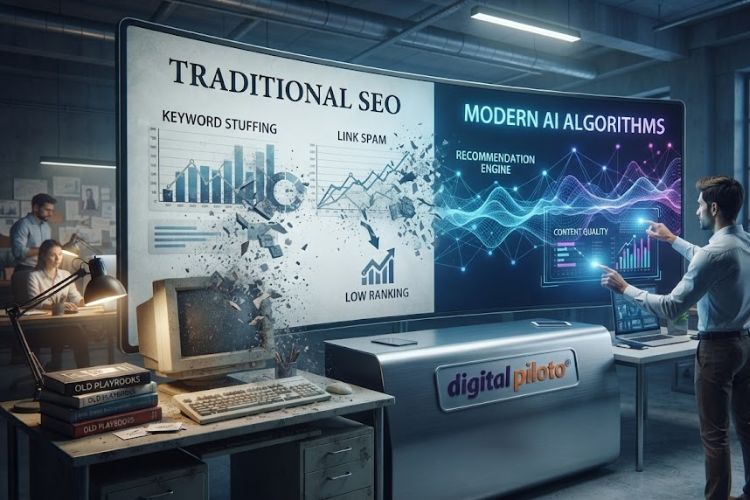

Traditional SEO strategies are losing effectiveness because search engines no longer rely primarily on keywords, backlinks, and technical signals to determine rankings. Today’s algorithms evaluate context, expertise, user satisfaction, topical authority, and content usefulness. Businesses that continue using outdated tactics often see slower growth, even when they follow what used to be considered SEO best practices.
The shift has been gradual enough that many marketers failed to notice it happening. Yet the evidence is everywhere. Websites publishing keyword-heavy articles and building large numbers of low-quality links are struggling to compete with brands focused on expertise and user experience. Many organizations working with a digital marketing company in Patna are now investing more heavily in semantic search optimization and topical authority than traditional ranking tactics.
What Is Traditional SEO?
Traditional SEO is an optimization approach centered around keyword targeting, backlink acquisition, metadata optimization, and technical improvements designed to improve search rankings.
For more than a decade, the formula was relatively predictable. Identify a target keyword, create a page around it, optimize headings and metadata, then build backlinks to increase authority.
That approach still has value, but it no longer delivers the same competitive advantage it once did.
Why Are Traditional SEO Strategies Losing Effectiveness?
The short answer is simple: search engines have become much better at understanding people.
Instead of matching exact phrases, algorithms now interpret intent, context, and meaning. They evaluate whether content actually solves a user’s problem rather than simply mentioning the right keywords.
This shift has reduced the effectiveness of several long-standing SEO tactics:
- Exact-match keyword repetition
- Publishing thin content around keyword variations
- Mass link-building campaigns
- Creating separate pages for nearly identical search terms
- Writing primarily for crawlers rather than readers
The Decline of Keyword-First Content
There was a time when using the target phrase every few sentences genuinely improved rankings.
Today, excessive optimization often creates content that feels unnatural and repetitive. Readers notice it immediately, and increasingly, search engines do too.
Modern algorithms understand related concepts, synonyms, and contextual relationships. An article about AI search visibility does not need to repeat the exact phrase twenty times to prove relevance.
In many cases, natural language performs better than forced optimization.
Backlinks Matter Differently Now
Backlinks remain important, but the rules surrounding them have changed significantly.
A single mention from an authoritative publication can now provide more value than dozens of links from unrelated websites.
Search engines increasingly evaluate:
- Topical relevance of the linking source
- Context surrounding the link placement
- Authority and trustworthiness of the publisher
- Brand recognition across the web
- User engagement after arriving on the page
The era of treating backlinks as a simple numbers game is fading quickly.
Search Intent Has Become the New Ranking Factor
One of the biggest reasons traditional SEO is becoming less effective is the rise of intent-based search.
Two pages targeting the same keyword can produce dramatically different results if one better answers the underlying question.
Consider someone searching for “local SEO pricing.”
They may want service costs, pricing models, implementation guidance, or agency recommendations. Search engines increasingly reward pages that understand and satisfy the real need behind the query.
How AI Search Is Reshaping Optimization
Artificial intelligence is transforming how information is discovered and evaluated.
AI-powered search systems analyze content similarly to how an experienced researcher would. They look for expertise, credibility, completeness, and logical structure.
Businesses are responding by working with specialists such as a generative engine optimization agency to improve visibility within AI-generated search results and conversational search experiences.
This evolution is creating a new layer of optimization beyond traditional rankings.
How Businesses Should Adapt: Step by Step
Step 1: Build Topic Authority
Focus on becoming genuinely useful within a specific subject area instead of chasing hundreds of unrelated keywords.
Step 2: Write for Questions, Not Keywords
Create content that directly answers user concerns in natural language.
Step 3: Improve User Experience
Fast loading times, mobile usability, and intuitive navigation increasingly influence performance.
Step 4: Structure Content for AI Extraction
Use clear headings, concise explanations, bullet lists, and schema markup.
Step 5: Strengthen Brand Signals
Mentions, reviews, expertise demonstrations, and thought leadership contribute to trust.
Traditional SEO Practices That Still Matter
Not every traditional tactic has become obsolete.
Several foundations remain essential:
- Technical SEO health
- Logical internal linking
- High-quality backlinks
- Structured metadata
- Content updates and maintenance
The difference is that these elements now support broader authority-building strategies instead of carrying campaigns on their own.
The New SEO Equation
The modern search formula is less mechanical and more human.
Visibility increasingly comes from expertise, trust, and usefulness rather than optimization tricks.
Brands that consistently educate, solve problems, and create genuinely valuable experiences are finding it easier to adapt to every algorithm update.
Ironically, SEO is becoming less about search engines and more about people.
Frequently Asked Questions
Is traditional SEO dead?
No. Traditional SEO fundamentals still matter, but they are no longer enough on their own to achieve strong visibility.
Why is keyword stuffing ineffective today?
Search engines understand context and semantic meaning, making excessive repetition unnecessary and potentially harmful.
Do backlinks still help rankings?
Yes. However, relevance, authority, and context are now more important than volume.
What replaced traditional SEO strategies?
Search intent optimization, topical authority, user experience, and semantic relevance have become increasingly important.
How should businesses prepare for future SEO changes?
Businesses should prioritize expertise, structured content, AI visibility, and audience trust.
Conclusion
Traditional SEO did not suddenly stop working. Instead, search engines became better at identifying content that genuinely deserves attention. Businesses that adapt to this reality will continue earning visibility, while those relying solely on old formulas may gradually lose relevance in an increasingly intelligent search environment.
Blog development credits
This article was shaped through strategic direction from Amlan Maiti, developed with research support from advanced AI platforms including ChatGPT, Gemini, and Copilot, and finalized with optimization expertise provided by Digital Piloto Private Limited.