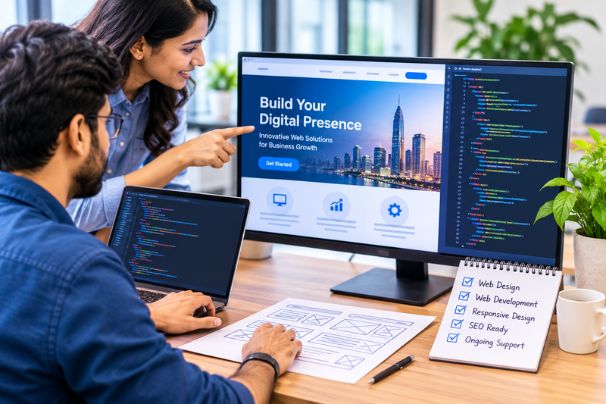

A professional website is more than an online presence; it is an important business asset that helps attract customers, communicate brand value and generate enquiries. Choosing the right Web Design And Development Company in India can help businesses build a secure, responsive and scalable digital platform that supports their long-term objectives. From startups establishing their first website to established companies upgrading outdated platforms, professional web development creates opportunities for sustainable online growth.
However, selecting a development partner involves more than comparing attractive designs or initial quotations. Businesses must evaluate technical capabilities, user experience, search engine readiness, development costs and ongoing support before making a decision.
What Does a Web Design and Development Company Do?
A web design and development company plans, designs, builds and maintains websites according to business requirements. Web design focuses on the website’s visual appearance, layout, navigation and user experience, while web development involves implementing its functionality, integrations and technical infrastructure.
A professional development team brings these disciplines together to create websites that look appealing, function reliably and provide a convenient experience across different devices. The objective is to build a digital platform that supports business operations and makes it easier for visitors to take meaningful actions.
Essential Services Offered by a Web Design and Development Company in India
Most professional development companies offer different services depending on their technical expertise and project requirements.
1. Custom Website Design
Custom website design involves creating layouts, visual elements, colour schemes and navigation structures that reflect a company’s identity. Unlike generic templates, custom designs can be planned around specific audiences, brand guidelines and conversion objectives.
2. Responsive Website Development
Responsive development ensures that website content adapts to different screen sizes, including smartphones, tablets and desktops. A consistent mobile experience improves accessibility and usability. It also supports Google’s mobile-first indexing approach, which uses the mobile version of a website for indexing.
3. CMS-Based Website Development
Content management systems such as WordPress allow businesses to update website pages, publish blogs, manage media and maintain content without regularly modifying source code. CMS-based solutions are useful for companies that require flexibility and frequent content updates.
4. Ecommerce Website Development
Ecommerce development helps businesses establish online stores with product catalogues, shopping carts, payment gateways, inventory management and order processing. Platforms such as Shopify and WooCommerce provide different approaches to managing online retail operations.
5. Custom Web Application Development
Businesses with specialised operational requirements may need custom web applications rather than conventional websites. These applications can include customer portals, booking systems, employee dashboards, CRM integrations and automated workflows.
6. Website Maintenance and Support
Website maintenance includes software updates, security monitoring, backup management, performance improvements, bug fixing and technical support. Regular maintenance helps keep a website functional and reduces the risk of avoidable technical problems.
Why Should Businesses Hire a Professional Website Development Company?
Working with an experienced development partner can provide several advantages beyond creating an attractive website.
- Better user experience: Clear navigation, logical page structures and intuitive interfaces make it easier for visitors to find information.
- Improved brand credibility: A professional website communicates business information, services and brand identity consistently.
- Mobile accessibility: Responsive layouts allow customers to access website content across different devices.
- Search engine readiness: Proper technical structure, crawlable links, descriptive URLs and organised content help search engines understand website pages.
- Business scalability: A well-planned technical architecture makes it easier to introduce new features as business requirements change.
- Better conversion opportunities: Strategically placed enquiry forms, calls to action and clear service information encourage visitors to contact a business.
How Much Does Website Development Cost in India?
Website development costs in India depend on project complexity, design requirements, number of pages, functionality, technology and the development team’s expertise. A basic informational website generally requires a smaller investment than a customised ecommerce platform or complex web application.
The following figures are indicative planning ranges, not fixed industry rates or Digital Piloto quotations.
| Website Type | Indicative Development Budget |
|---|---|
| Basic business website | ₹10,000–₹40,000 |
| Custom business website | ₹25,000–₹1,50,000 |
| Ecommerce website | ₹50,000–₹3,00,000 |
| Custom web application | ₹3,00,000 onwards |
These estimates are broad and can vary significantly with the scope of work. For example, a store with a small product catalogue may cost considerably less than an ecommerce platform requiring advanced inventory management, multiple payment integrations and automated shipping workflows.
Businesses should also account for domain renewal, hosting, premium plugins, third-party software subscriptions, content creation, security services and ongoing maintenance. Requesting an itemised quotation helps prevent unexpected expenses.
Which Technologies Are Used for Website Development?
The appropriate technology depends on the website’s intended functionality, budget and future requirements.
- HTML, CSS and JavaScript: Core technologies for structuring, styling and adding interactive behaviour to websites.
- React and Next.js: Technologies used to build interactive and modern web applications.
- PHP and Laravel: Common choices for backend development and customised web solutions.
- WordPress: A flexible CMS for business websites, blogs and content-driven platforms.
- Shopify: An ecommerce platform for businesses managing online stores.
- MySQL and other databases: Used to store and organise application and website information.
A reliable development company should recommend technologies based on project needs instead of selecting tools simply because they are popular.
How to Choose the Right Web Design and Development Company in India
Before hiring a development partner, evaluate the following considerations:
- Review the portfolio: Examine previous projects to understand the company’s design quality, technical capabilities and experience across industries.
- Understand the development process: Ask about requirement analysis, wireframing, design approvals, development, testing and deployment.
- Check SEO and performance knowledge: Ensure the team understands website structure, mobile usability, loading performance and technical SEO fundamentals.
- Clarify project ownership: Confirm access to the domain, hosting account, source code, CMS and other essential assets.
- Compare quotations: Evaluate deliverables, timelines, revisions, integrations and exclusions instead of choosing solely on price.
- Discuss post-launch support: Understand maintenance arrangements, security updates and technical assistance after deployment.
The right partner should understand your business objectives and translate them into practical design and development decisions.
Why Website Development and Digital Marketing Should Work Together
A website becomes more valuable when its development is aligned with the broader digital marketing strategy. Search engine optimisation, content planning, conversion rate optimisation and analytics should be considered during website planning rather than treated as completely separate activities.
For example, a healthcare website needs clear service information, accessible appointment enquiries and trustworthy content. A clinic looking to attract patients can also explore a Digital Marketing Agency for Doctor in Bangalore to understand how targeted digital marketing can support online visibility and patient enquiries.
Similarly, ecommerce businesses can benefit from integrating product SEO, analytics, conversion tracking and marketing automation into their online stores.
What Is the Typical Website Development Process?
A structured development process helps businesses maintain project clarity and reduce unnecessary revisions.
- Requirement discovery: Identify business objectives, target audiences, features and technical requirements.
- Planning and wireframing: Organise website pages, navigation and user journeys.
- UI/UX design: Create the visual layout and interactive experience.
- Development: Build frontend and backend functionality and integrate required tools.
- Testing: Check responsiveness, functionality, accessibility, security and browser compatibility.
- Deployment: Configure hosting, domain settings and launch the completed website.
- Maintenance: Monitor performance, resolve issues and introduce improvements.
Frequently Asked Questions
How long does it take to develop a business website?
A basic business website may take a few weeks, while complex ecommerce platforms and custom applications can require several months. The timeline depends on functionality, content readiness, integrations and approval cycles.
Is WordPress suitable for business website development?
Yes. WordPress is suitable for many business websites, blogs and content-driven platforms. Its flexibility, content management features and plugin ecosystem make it a practical option for businesses that require regular updates.
Does website development include SEO?
Not necessarily. Some development packages include technical SEO foundations, such as mobile responsiveness, crawlable navigation and basic metadata configuration. Content optimisation, keyword research and ongoing SEO campaigns may require separate services.
What should be included in a website development quotation?
A detailed quotation should specify design, page count, functionality, technology, integrations, content responsibilities, testing, delivery timeline, ownership, payment terms and post-launch support.
Why should businesses choose a custom website?
Custom websites are useful when a business requires specific branding, functionality, integrations or user journeys that standard templates cannot adequately support. However, simpler projects may be better served by a well-configured CMS or ecommerce platform.
Build a Website That Supports Your Business Growth
Choosing the right web development partner is an important investment in your company’s digital future. A successful website should combine attractive design, reliable functionality, responsive layouts, search engine readiness and a clear user journey.
Digital Piloto Pvt. Ltd. provides website design, responsive development, CMS-based solutions, ecommerce development and custom web development services. With a focus on connecting technology with business objectives, the company helps businesses develop digital platforms suited to their requirements.
If you are planning a new website or upgrading an existing one, explore Digital Piloto’s web development services in India and discuss your project requirements with the team.
Also Read: A Complete Guide to Finding the Right Web Development Partner in India
Blog Development Credits:
This article idea was originally shaped by Amlan Maiti. It was researched and drafted using AI platforms such as ChatGPT, Gemini, and Copilot, and later refined with SEO insights from Digital Piloto Private Limited.