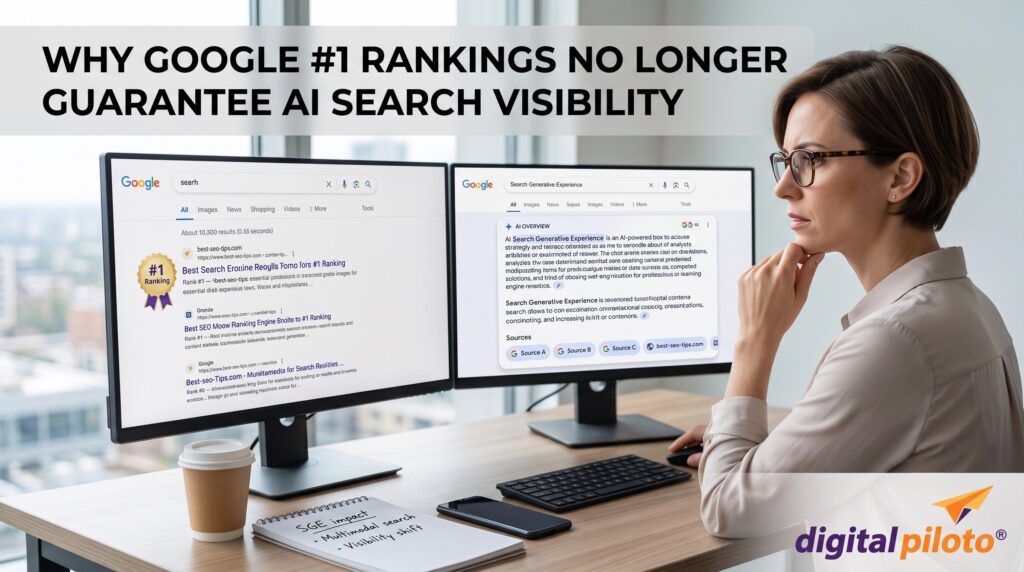

For years, reaching Google’s #1 position felt like winning the search game. But AI Overviews, AI Mode, and conversational search have changed what visibility means. A page can dominate a traditional results page and still be absent from an AI-generated answer. The question now is no longer simply, “Can Google rank us?” but, “Can AI understand, trust, and cite us?”
That shift matters for every digital marketing agency planning organic growth around search. A first-place ranking remains valuable, but it is no longer a complete picture of how customers discover a business, evaluate alternatives, or reach a buying decision.
The Meaning of “Visibility” Has Changed
Traditional SEO largely revolves around a familiar journey: someone searches, Google returns a list of pages, and the user chooses one. The higher your page appears, the more opportunities you have to earn that click.
AI search introduces another layer.
Instead of simply presenting ten blue links, Google’s AI experiences can synthesize information from multiple sources and provide a conversational response. Google explains that AI Overviews and AI Mode can use related searches across different subtopics to develop an answer and surface supporting links from a broader set of pages. Google Search Central also makes clear that traditional SEO fundamentals remain important for these experiences.
In practical terms, this means there are now at least two different questions:
- Traditional visibility: How prominently does my page appear for a query?
- AI visibility: Is my information useful, understandable, trustworthy, and relevant enough to be selected as part of an AI-generated response?
- Business visibility: Does that exposure lead the right person toward a meaningful action?
Those three outcomes can overlap, but they are not identical. That is where many established SEO strategies begin to show their limitations.
A #1 Ranking Does Not Mean an AI Citation
Here is the misconception worth retiring: “If I rank first, AI will automatically mention me.” There is no such guarantee.
Google’s current documentation says a page must be indexed and eligible to appear in Search with a snippet to be eligible as a supporting link in AI Overviews or AI Mode. But Google also explicitly notes that satisfying technical requirements and best practices does not guarantee that a page will be crawled, indexed, or served. Its generative AI search guidance also describes AI search as being grounded in Google’s broader Search systems.
So a #1 ranking gives you an important foundation. It does not hand you a permanent seat inside every AI answer.
Imagine a restaurant sitting directly beside a busy railway station. Its location is excellent. Yet when a customer asks a food guide to recommend places based on atmosphere, dietary requirements, price, distance, and opening hours, location alone does not determine the recommendation.
AI search works in a similarly contextual way. It can evaluate the question differently from the way a conventional keyword query is evaluated.
AI Search Often Solves a Larger Question
Traditional queries are frequently compact. Someone might type “best CRM software” or “SEO company India.” AI search encourages more detailed questions such as:
“Which CRM is suitable for a 30-person B2B sales team that needs automation but has a limited implementation budget?”
That is not simply a keyword. It is a bundle of intent, constraints, comparison criteria, and implied follow-up questions.
This is one reason why ranking for a broad head term does not necessarily translate into AI visibility. A page may be perfectly optimized for “best CRM software” while offering little original information about team size, implementation complexity, integration limitations, or actual decision criteria.
AI systems need material they can use to construct a useful answer. Generic summaries are therefore less strategically interesting than pages containing clear explanations, original observations, useful comparisons, evidence, examples, and well-defined entities.
The Click Economy Is Changing Too
The commercial impact of this shift is easy to underestimate.
A Pew Research Center analysis of browsing behavior from 900 U.S. adults found that 58% encountered at least one Google search with an AI-generated summary during March 2025. More importantly for publishers and businesses, traditional search-result links were clicked in 8% of visits where an AI summary appeared, compared with 15% where one did not. Links within the AI summaries themselves were clicked in just 1% of visits in that study.
That does not mean websites are becoming irrelevant. It means the value of appearing in search can no longer be judged only by traditional click-through rate.
A brand might be mentioned, cited, compared, summarized, or used as supporting evidence before a customer ever visits its website. In other cases, the customer may never click at all.
That creates a broader concept of AI search visibility: being present in the information layer that influences the customer’s decision, not merely occupying a position on a results page.
What AI Systems Need From Your Content
1. Clear answers before clever copy
AI-friendly content does not have to sound robotic. Quite the opposite. The strongest pages often explain complicated subjects plainly, answer important questions directly, and then add depth.
If a page takes 600 words to finally explain what a product does, it creates unnecessary friction for both people and machines. Start with the answer. Then provide evidence, context, limitations, examples, and practical implications.
2. Distinctive information
Suppose twenty websites publish almost identical explanations of “what is technical SEO?” An AI system has little reason to repeatedly surface every version.
Your opportunity is to contribute something distinguishable: a documented process, original research, first-hand experience, meaningful examples, expert commentary, proprietary data, or a genuinely useful framework.
Google’s May 2026 guidance specifically emphasizes valuable, unique and non-commodity content for generative AI features.
3. Strong topical connections
A page rarely exists in isolation. Your website should help search systems understand how your services, authors, products, locations, topics, and supporting resources relate to one another.
That is where internal linking becomes more than an SEO housekeeping exercise. A thoughtful internal architecture creates a clearer map of your expertise.
Why Generic Content Can Lose the AI Race
There is a strange irony in the AI era: producing content has become easier, but producing content worth selecting can become harder.
Businesses can now create dozens of articles around closely related keywords in a short period. The problem is that volume does not automatically create authority. If ten pages say essentially the same thing, publishing the eleventh may add very little.
Google’s guidance on generative AI content warns against generating large numbers of pages without adding value. Its Search Essentials also stress that meeting technical requirements alone does not guarantee indexing or serving.
For businesses, the better question is not “How many blogs can we publish this month?” It is “What useful information can our website uniquely contribute to the conversation?”
GEO Is Not a Replacement for SEO
This is where the phrase generative engine optimization enters the discussion. Many businesses treat GEO as a completely separate discipline that requires abandoning conventional SEO. Google’s own documentation does not support that interpretation.
Its guidance states that the existing foundations of SEO remain relevant to AI features. Technical accessibility, crawlability, indexability, useful content, internal linking, page experience, and accurate structured data still matter.
What changes is the strategic objective around those fundamentals.
A modern generative AI SEO agency should therefore think beyond ranking positions and examine whether a brand’s information can be understood and surfaced across more conversational, comparative, and multi-step search journeys.
That could mean building content around questions customers ask after the initial query, clarifying product and service entities, strengthening author credibility, publishing original evidence, and creating supporting pages that answer related subtopics.
Five Signals Worth Auditing Beyond Rank
If your website already ranks well, do not throw away the SEO strategy that got you there. Instead, add another layer of measurement.
- AI inclusion: Are your important pages appearing in AI-generated search experiences for relevant queries?
- Citation consistency: When your brand is mentioned, are the facts accurate and supported by your own website?
- Topic coverage: Does your site answer the follow-up questions surrounding your core commercial topics?
- Entity clarity: Can users and search systems easily understand who you are, what you offer, where you operate, and who your expertise serves?
- Conversion quality: Are AI-assisted visitors, organic visitors, and direct visitors behaving differently once they reach the site?
Google has also made measurement more practical. In June 2026, Google announced dedicated Search Generative AI performance reports in Search Console, showing impressions, pages, countries, devices, and dates associated with generative AI features. Google stated that these insights had rolled out worldwide by August 31, 2026.
That is an important development because businesses can begin separating “we rank” from “we appear in generative search experiences.”
What a Future-Ready Search Strategy Looks Like
The answer is not to stop chasing rankings. Rankings still matter because Google says its AI search experiences are rooted in its core Search and quality systems. The smarter approach is to build a search strategy with multiple layers.
- Technical foundation: Keep important pages crawlable, indexable, fast, accessible, and internally connected.
- Search relevance: Continue targeting genuine customer needs and commercially meaningful queries.
- Answer depth: Build content that handles the primary question as well as the natural follow-up questions.
- Original expertise: Add information competitors cannot easily reproduce.
- Brand clarity: Make your organization, services, people, locations, products, and claims easy to understand.
- Measurement: Track rankings, organic traffic, conversions, branded demand, and AI search visibility together.
For companies investing in local growth, this broader approach also applies to local search. A business might rank strongly for a local keyword but still need clear service descriptions, accurate business information, useful local content, and credible references to become a stronger source for conversational discovery. A well-planned SEO service Kolkata strategy should therefore connect local SEO with the wider customer journey rather than treating rankings as the finish line.
The Real Risk of Focusing Only on Position #1
The biggest danger is not losing a ranking. It is misunderstanding what the ranking represents.
A #1 result can tell you that your page is highly competitive within a particular traditional search context. It cannot, by itself, tell you whether an AI system will use your information when the user asks a longer question, changes the wording, adds constraints, requests a comparison, or starts a follow-up conversation.
That distinction becomes even more important as people get accustomed to AI-assisted search. Pew Research Center reported in June 2026 that 60% of U.S. adults said they had read AI summaries at the top of search-engine results.
The search interface is becoming part of the decision-making environment. Your website therefore needs to be useful before the click, during the click, and after the click.
FAQs
Does a #1 Google ranking guarantee AI Overview visibility?
No. A strong traditional ranking can support eligibility and discovery, but it does not guarantee inclusion in AI Overviews or AI Mode. Google says AI features can surface relevant supporting links using its broader Search systems, and individual responses and links can vary.
Is SEO still important for AI search?
Yes. Google explicitly states that existing SEO best practices remain relevant to its generative AI search experiences. Crawlability, indexability, helpful content, internal linking, page experience, and accurate structured data continue to matter.
What should businesses measure besides Google rankings?
Track AI-feature impressions where available, pages surfaced in generative experiences, organic traffic, branded searches, assisted conversions, engagement, and qualified leads. Together, these metrics provide a broader view of search visibility and business impact.
Does GEO replace traditional SEO?
No. GEO should be treated as an extension of a broader search strategy rather than a substitute for SEO. Strong technical foundations and genuinely useful content remain central to visibility across Google’s evolving search experiences.
Final Thoughts
The era of treating “#1 on Google” as the entire definition of search success is fading. Rankings still matter, but customers can now encounter your brand through summaries, synthesized answers, comparisons, follow-up questions, and AI-generated journeys.
The winning mindset is not to choose between SEO and AI search. It is to build a website that deserves visibility in both. Make your information accessible, distinctive, trustworthy, connected, and genuinely useful. A ranking may open the door, but in AI search, the quality of what lies behind that door increasingly determines whether your brand gets remembered.
Blog Development Credit
Conceptualized by Amlan Maiti, this article was researched and developed with ChatGPT, Google Gemini and Copilot, then refined for SEO by Digital Piloto Private Limited.