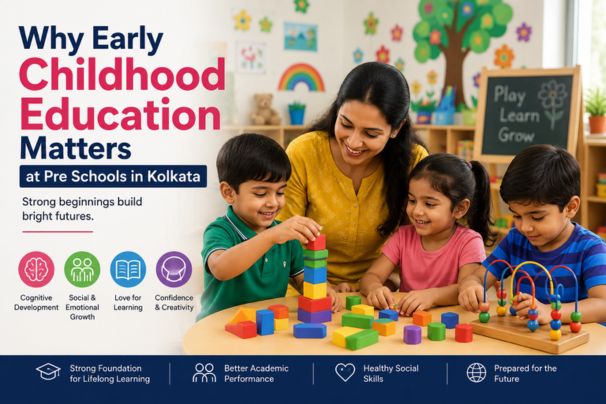

Early childhood education plays a vital role in shaping a child’s cognitive, emotional, social, and physical development. During the first few years of life, children absorb knowledge rapidly, making this the ideal time to introduce structured learning through play, exploration, and interaction. Choosing quality Pre Schools in Kolkata gives children the opportunity to develop essential life skills that support both academic success and personal growth.
Many parents believe preschool is simply a place where children learn the alphabet and numbers. In reality, it is where they begin building confidence, communication skills, emotional intelligence, and curiosity. A thoughtfully designed preschool environment lays the foundation for lifelong learning while helping children transition smoothly into formal education.
What Is Early Childhood Education?
Early childhood education refers to the structured learning and developmental experiences provided to children before they enter primary school. It focuses on nurturing intellectual, social, emotional, language, and motor skills through age-appropriate activities rather than traditional classroom instruction.
Core Areas of Early Childhood Education
- Language and communication development
- Social and emotional learning
- Creative thinking and imagination
- Fine and gross motor skill development
- Problem-solving and critical thinking
- Independence and self-confidence
Instead of memorizing information, young children learn best through storytelling, music, hands-on activities, creative play, and interaction with teachers and classmates.
Why Is Early Childhood Education So Important?
Research consistently shows that the experiences children have during their early years significantly influence future academic achievement and emotional well-being. The brain develops rapidly during this stage, creating strong neural connections that support learning throughout life.
A quality preschool encourages children to ask questions, solve simple problems, express their feelings, and develop positive relationships. These experiences build the confidence needed for future classroom success.
Key Benefits of Early Childhood Education
- Develops communication and language skills
- Encourages curiosity and creativity
- Improves concentration and listening abilities
- Builds emotional resilience and confidence
- Strengthens social interaction and teamwork
- Creates positive learning habits from an early age
How Pre Schools Prepare Children for Formal Education
The transition from home to school can feel overwhelming for young children. Preschool bridges this gap by introducing routines, structured activities, and collaborative learning in a nurturing environment.
Step-by-Step Learning Journey
1. Building Daily Routines
Children learn to follow schedules, manage simple responsibilities, and become comfortable with classroom routines.
2. Developing Communication Skills
Teachers encourage children to express thoughts, ask questions, listen carefully, and interact confidently with peers.
3. Encouraging Independent Learning
Simple activities like organizing belongings, making choices, and completing tasks independently foster responsibility and confidence.
4. Introducing Foundational Concepts
Children gradually learn letters, numbers, shapes, colors, patterns, and basic problem-solving through engaging activities rather than formal instruction.
5. Preparing for Primary School
The confidence and foundational skills developed during preschool make the transition to Primary Schools in South Kolkata much smoother and less stressful for both children and parents.
Why Play-Based Learning Is More Effective Than Traditional Teaching
Young children learn naturally through play. Building blocks improve problem-solving, storytelling strengthens vocabulary, art encourages creativity, and group games teach cooperation.
Rather than forcing academic pressure too early, quality preschool programs balance structured learning with exploration. This approach helps children retain concepts more effectively while enjoying the learning process.
Also Read: Top Benefits of Studying in a School under ICSE Board in Kolkata
Skills That Last Beyond the Classroom
One of the greatest advantages of early childhood education is that it develops life skills, not just academic knowledge.
Essential Skills Children Gain
- Confidence in new situations
- Respect for others
- Patience and self-control
- Decision-making abilities
- Teamwork and collaboration
- Adaptability to changing environments
These qualities continue to benefit children throughout school, college, and eventually their professional lives. Academic excellence often begins with strong emotional and social development.
How Parents Can Support Early Learning at Home
Education does not stop when children leave preschool. Parents play an equally important role in reinforcing positive learning experiences at home.
Simple Ways to Encourage Learning
- Read books together every day
- Allow time for creative play
- Encourage questions and conversations
- Praise effort instead of perfection
- Create consistent daily routines
- Limit unnecessary screen time
When schools and parents work together, children receive consistent encouragement that strengthens both learning and emotional security.
FAQs
At what age should a child start preschool?
Most children begin preschool between the ages of two and four years, depending on their developmental readiness and the school’s admission criteria.
Does preschool improve communication skills?
Yes. Preschool encourages children to interact with teachers and classmates through conversations, storytelling, songs, and group activities, helping them develop strong communication skills.
Why is play-based learning important in preschool?
Play-based learning helps children understand concepts naturally while improving creativity, problem-solving, coordination, and social interaction without creating unnecessary academic pressure.
How does preschool prepare children for primary school?
Preschool introduces routines, classroom behavior, foundational literacy and numeracy, social interaction, and independent learning, making the transition to primary education much easier.
What should parents look for when choosing a preschool?
Parents should evaluate the curriculum, teacher qualifications, safety standards, child-friendly infrastructure, learning approach, class size, and overall environment before making a decision.
Conclusion
Early childhood education is one of the most valuable investments parents can make in their child’s future. Beyond academics, it nurtures confidence, curiosity, creativity, and emotional well-being during the years when learning happens most naturally. A high-quality preschool provides children with the right environment to explore, grow, and develop the skills they need to thrive throughout their educational journey and beyond.
Blog Development Credits:
This blog was envisioned by Soumyajit Sardar, created with research support from advanced AI platforms like ChatGPT, Gemini, and Copilot. Final editing and SEO expertise were provided by G.D. Birla Centre for Education.