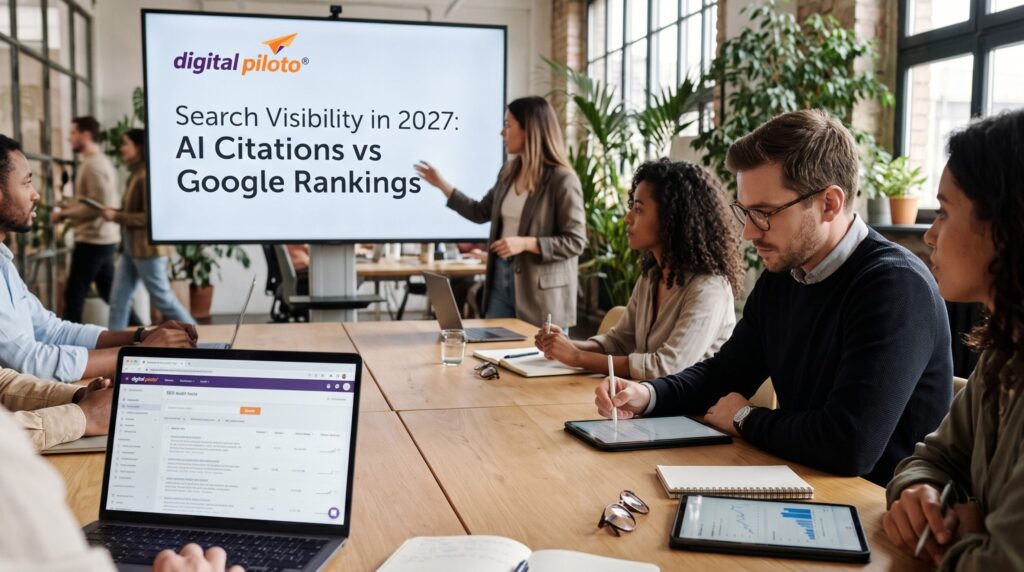

Search visibility used to have a fairly familiar scoreboard: rank higher on Google, attract clicks, and turn visitors into customers. In 2027, that picture is changing. People still use traditional search results, but they increasingly discover businesses through AI-generated answers and recommendations. For brands, the challenge is no longer simply getting found; it is becoming a trusted source worth mentioning.
Consider someone searching for a reliable software development partner. They might scan Google’s results, compare websites, and visit a few service pages. Alternatively, they may ask an AI assistant to recommend suitable companies and explain which one fits their needs. A digital marketing company in India now needs to understand both journeys. A strong Google position can bring valuable traffic, while an accurate AI citation can introduce a brand much earlier in the decision-making process.
Search Visibility Has Become a Two-Part Challenge
Traditional SEO and AI search optimization are connected, but they do not operate in exactly the same way. Google rankings generally determine where a page appears among search results for a particular query. AI-powered search experiences, meanwhile, may interpret a question, gather information from multiple sources, and produce a summarized response with selected citations or recommendations.
Think of Google rankings as securing a prominent position on a busy shopping street. Your storefront is visible, and people can decide whether to walk inside. AI citations are closer to having a knowledgeable guide recommend your shop while explaining why it suits a particular customer. Both forms of exposure matter, but they influence discovery differently.
This distinction creates two important objectives for businesses:
- Earn traditional search visibility: Build relevant pages that can rank for valuable keywords and attract visitors with genuine intent.
- Earn AI visibility: Publish clear, credible, well-supported information that AI systems can retrieve, interpret, and potentially reference.
- Convert discovery into business value: Make sure the experience after discovery gives people a convincing reason to enquire, subscribe, or purchase.
These objectives should support one another rather than compete for budget or attention.
Google Rankings Still Matter in 2027
It would be a mistake to treat traditional SEO as yesterday’s marketing strategy. Search engines remain important discovery channels for product comparisons, local services, technical questions, and commercial research. Many people still prefer to inspect several websites before making a decision, particularly when a purchase involves significant money or long-term commitment.
Google rankings also provide a useful indication of how well a website matches particular search needs. A page that consistently performs for relevant terms may be reaching an audience with a clear interest in its subject. That visibility can generate organic visits, enquiries, brand recognition, and opportunities to build relationships.
What strong Google rankings can deliver
- Consistent discovery: Well-maintained pages can attract visitors over time without requiring a separate payment for every click.
- Intent-based traffic: Keyword research helps businesses reach people searching for specific products, services, or solutions.
- Measurable performance: Search Console and analytics tools help teams examine impressions, clicks, queries, and landing-page behaviour.
- Content opportunities: Ranking data can reveal unanswered questions, weak pages, and topics worth developing further.
Google’s own documentation on AI features in Search explains that established search fundamentals remain relevant to appearing in AI experiences. In other words, businesses do not need to abandon sound technical SEO, useful content, or accessible website architecture to adapt to new search formats.
Why AI Citations Are Becoming a Visibility Signal
AI citations represent a different kind of digital exposure. When an AI-powered platform references a business website while answering a question, the brand may gain visibility even if the user never visits a conventional results page.
Imagine a business owner asking, “What should I look for when choosing an SEO partner for an ecommerce website?” An AI response might discuss technical expertise, product-page optimization, content strategy, and conversion tracking. If a company’s useful explanation is cited as a supporting source, that business becomes part of the user’s research journey.
There is an important distinction here: a citation is not automatically an endorsement. A source may be referenced for one specific fact or explanation. Likewise, a brand mention without a clickable source link may create awareness without generating referral traffic.
What makes a page easier to reference?
AI systems can use information from different sources, depending on the platform, query, retrieval process, and available data. No single formatting trick guarantees inclusion. However, businesses can make their information more useful and understandable by focusing on several practical elements:
- Clear answers: Explain important concepts directly before expanding into detailed discussion.
- Specific expertise: Include practical examples, original observations, and explanations that demonstrate subject knowledge.
- Reliable evidence: Support factual claims with credible sources and keep information current.
- Consistent identity: Maintain accurate business details, service descriptions, author information, and contact information across relevant platforms.
- Logical structure: Use descriptive headings, meaningful sections, and appropriate internal links to make relationships between topics clear.
This is where AI search visibility becomes a broader content and reputation challenge. A brand needs more than a collection of keyword-focused pages. It needs information that is genuinely helpful when someone asks a detailed question.
AI Citations vs Google Rankings: The Key Differences
Although both approaches help people discover information, their measurement and business impact can differ.
1. Visibility is measured differently
Google rankings can be monitored through keyword positions, impressions, clicks, and organic traffic. AI citations require additional observation: which prompts mention the brand, which pages are referenced, how accurately the brand is described, and whether those appearances happen consistently.
2. The search journey is different
A traditional search often presents multiple options for users to explore. An AI response may summarize several considerations in one place. This can shorten the initial research process, although users may still visit websites to verify claims, compare providers, or complete a transaction.
3. Content needs to communicate context
A page can rank for a keyword while offering limited depth. AI-oriented discovery places additional practical importance on whether the information explains a subject clearly and answers the question in context. A service page, for example, should describe not only what a company offers but also whom it helps, what problems it addresses, and what customers should consider before choosing that service.
4. The metrics should not be combined blindly
A rise in Google clicks and an increase in AI citations are not interchangeable achievements. One indicates activity in traditional search; the other indicates visibility in selected AI responses. Businesses should monitor both and examine whether either contributes to qualified leads, enquiries, or sales.
Building a Search Strategy That Supports Both
The most practical approach is not to create two completely separate marketing systems. It is to develop a strong information foundation that serves people across different discovery channels.
Start with search intent, not just keywords
Keyword research remains useful, but a list of search terms does not explain the full customer journey. Consider what a person wants to understand before choosing a service. Someone searching for “SEO services” may be exploring options, while someone asking how to recover lost organic traffic may already have a specific problem and a stronger reason to contact an expert.
Build content around these different needs. Include educational articles, comparison guides, detailed service pages, practical FAQs, and decision-support resources. This creates a connected content ecosystem rather than a collection of isolated posts.
Strengthen expertise and brand credibility
Search visibility depends partly on whether people and platforms can understand who is behind the information. Author profiles, transparent business details, accurate service descriptions, customer feedback, and relevant external references all help establish a clearer picture of a brand.
A digital transformation agency India should also think beyond publishing more articles. Its website needs to communicate expertise consistently across service pages, educational resources, case studies where available, and other relevant brand touchpoints. Publishing frequently without building credibility can create plenty of content but very little lasting authority.
Make technical foundations dependable
Technical SEO still matters because useful information needs to be accessible. A website should load reliably, work well on mobile devices, use logical navigation, and avoid unnecessary crawling or indexing obstacles. Structured data can help search engines interpret eligible information, but it should accurately reflect visible page content. It is not a shortcut to guaranteed AI citations or rich results.
For businesses reviewing their search strategy, working with the best SEO agency in India can help connect technical improvements, content planning, and performance measurement into a more coherent programme.
How to Measure Search Visibility in 2027
One of the biggest mistakes a business can make is judging its search performance through a single number. Ranking position alone cannot explain whether the right audience is discovering the brand. Equally, a handful of AI citations cannot prove that a business is generating meaningful demand.
A more balanced measurement framework should include:
- Organic performance: Track impressions, clicks, relevant keyword positions, and landing-page traffic through Google Search Console and analytics.
- AI citation coverage: Test a consistent set of relevant prompts across selected AI platforms and record when the brand or its pages appear.
- Citation quality: Check whether the cited page is accurate, relevant, current, and genuinely supportive of the answer.
- Brand search demand: Monitor whether more people are searching for the business by name or looking for its specific services.
- Business outcomes: Connect traffic and referral activity with enquiries, lead quality, conversions, and revenue where tracking permits.
AI responses can vary by platform, location, query wording, and time. Therefore, citation monitoring should use repeatable prompts and documented observations rather than relying on one isolated search. Treat the results as directional evidence, not a universal ranking report.
Common Mistakes Businesses Should Avoid
As interest in AI visibility grows, some businesses may be tempted to chase shortcuts. That can undermine the very credibility they are trying to build.
- Abandoning SEO: Traditional search remains valuable, and strong technical and content foundations support broader discoverability.
- Publishing generic AI-generated pages: More pages do not automatically create more authority. Each resource should add useful information or a distinct perspective.
- Forcing brand mentions: Repeating a company name unnaturally does not make content more trustworthy or useful.
- Assuming every citation drives sales: Visibility is an early-stage signal. It needs to be connected to actual customer behaviour.
- Ignoring accuracy: Outdated prices, inconsistent service details, and unsupported claims can weaken customer confidence.
Google’s guidance on creating helpful, reliable, people-first content offers a useful principle here: content should serve its intended audience rather than exist primarily to manipulate search systems. That advice remains relevant whether a visitor arrives through a blue link or an AI-generated answer.
Frequently Asked Questions
1. Are AI citations more important than Google rankings in 2027?
Neither is universally more important. Google rankings can generate valuable organic traffic, while AI citations can introduce a brand during conversational research. The right priority depends on customer behaviour, industry, and business goals. Most organizations benefit from improving both.
2. Can a website receive AI citations without ranking first on Google?
Yes. AI platforms may retrieve or reference information through different systems and sources. A page does not necessarily need to hold the top Google position to appear in an AI-generated response. However, strong SEO fundamentals can still support discoverability and content accessibility.
3. How can businesses improve their chances of being cited by AI?
Publish accurate, well-structured information that directly answers relevant questions. Demonstrate real expertise, maintain consistent brand details, use credible references, and keep important pages updated. There is no guaranteed method of securing a citation, so focus on usefulness and trust rather than tricks.
4. What should businesses track to measure AI search visibility?
Monitor brand mentions, linked citations, cited pages, answer accuracy, and visibility across a consistent set of relevant prompts. Compare these observations with organic search performance, referral traffic, enquiries, and conversions to understand their actual business value.
Final Thoughts: Build Visibility That Lasts
Search visibility in 2027 is not a contest between Google rankings and AI citations. It is a broader effort to make a business discoverable, understandable, and credible wherever customers look for answers. Strong SEO helps people find the website; useful, trustworthy information gives them a reason to remember the brand. Businesses that bring these strengths together will be better prepared for the next stage of search.
Blog Development Credits
The concept was developed by Amlan Maiti, with research and AI-assisted content development, followed by editorial refinement and SEO optimization from Digital Piloto Private Limited.