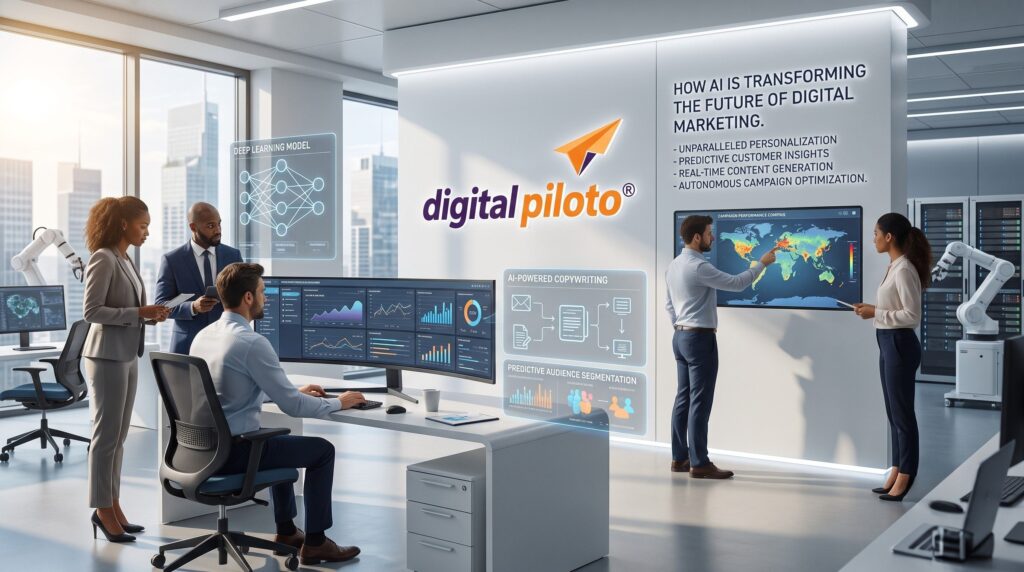

Digital marketing used to reward teams that could move quickly, test often, and understand their audiences. AI is changing that equation. From predictive analytics to conversational search, businesses can now turn enormous amounts of customer data into faster decisions and more relevant experiences. The real opportunity is not replacing marketers, but giving them sharper tools for better judgment.
Why AI Has Become a Marketing Game Changer
AI is no longer limited to futuristic experiments. It is steadily becoming part of everyday marketing workflows, from writing campaign variations to predicting customer behavior and identifying promising leads.
Recent U.S. Census Bureau research found that 18% of firms used AI in at least one business function during the November 2025–January 2026 period. Among companies already using AI, Sales and Marketing was the most common business function, used by 52% of adopters. U.S. Census Bureau research.
That is significant because marketing has always involved a balancing act: understand the customer, create something useful, deliver it at the right moment, and learn from the response. AI can make every part of that loop considerably faster.
AI Is Making Marketing More Predictive
Traditional marketing often looks backward. Teams review campaign performance, website traffic, conversion rates, and customer data to understand what happened.
AI adds another layer: what is likely to happen next?
Predictive marketing systems can examine patterns across customer journeys and identify signals that suggest someone may purchase, disengage, return, or respond to a particular offer. That gives marketers an opportunity to act before the outcome becomes obvious.
- Lead scoring: Identify prospects showing stronger buying signals.
- Churn prediction: Spot customers whose behavior suggests declining engagement.
- Demand forecasting: Estimate future interest in products, services, or campaigns.
- Campaign optimization: Adjust messaging and targeting based on emerging performance patterns.
The advantage is not perfect prediction. Marketing rarely works that way. The advantage is having a more informed starting point.
Personalization Is Becoming More Intelligent
“Personalized marketing” once meant adding someone’s first name to an email. That era is long gone.
AI can help brands interpret browsing behavior, purchase history, preferences, engagement patterns, and contextual signals to create experiences that feel more relevant. Instead of sending one campaign to everyone, marketers can potentially adapt content, offers, timing, and recommendations to different customer situations.
This shift is especially visible in India. Salesforce reported in July 2026 that 81% of surveyed Indian marketers had adopted AI, while fragmented customer data remained a major barrier to using it effectively. Salesforce India research.
That last point deserves attention. AI can personalize at scale, but only when the underlying data is reasonably accurate and connected.
Generative AI Is Changing Content Creation
Generative AI has also changed the economics of content production. A marketer can now explore several headline concepts, campaign angles, audience variations, or content outlines in minutes rather than starting every idea from a blank page.
But speed is not the same as quality. Publishing generic AI-generated material everywhere can actually make a brand less memorable.
The smarter approach is to use AI for acceleration while keeping human expertise responsible for:
- Brand voice and positioning
- Original insights and opinions
- Fact-checking and editorial judgment
- Customer empathy and cultural context
- Final approval and accountability
In other words, AI can help marketers produce more. Humans still need to decide what deserves to exist.
AI Is Reshaping Search and Websites
Search behavior is evolving as consumers increasingly use AI-generated answers and conversational interfaces to research products and services. That means digital visibility is no longer only about ranking a webpage for a traditional keyword.
Brands need useful information, strong entities, credible content, structured data, and experiences that work across both conventional search and AI-powered discovery.
This also makes the technical foundation important. A strong website development in India strategy can help businesses build fast, accessible, mobile-friendly websites that connect analytics, CRM systems, conversion tracking, and marketing technologies effectively.
The Rise of AI-Powered Customer Conversations
Marketing is gradually moving from one-way broadcasting toward two-way interaction. AI assistants, chatbots, recommendation engines, and conversational interfaces can respond to customers at moments when traditional campaigns might simply wait for a click.
Salesforce’s 2026 marketing research found that 92% of surveyed marketers in India said customers increasingly expect back-and-forth conversations with brands.
That changes the marketer’s job. Instead of asking only, “What should we publish?”, teams increasingly need to ask, “How should our brand respond when the customer starts the conversation?”
What Marketers Should Do Next
AI adoption does not need to begin with an enormous technology overhaul. A practical roadmap is usually more effective.
- Start with one valuable problem: Choose personalization, lead scoring, content workflows, or customer support.
- Clean the data: Remove duplicates, inconsistent fields, and disconnected customer records.
- Measure outcomes: Track conversions, customer value, response rates, and efficiency—not AI usage itself.
- Keep humans involved: Establish review processes for sensitive, creative, and customer-facing applications.
- Expand gradually: Scale successful experiments into repeatable marketing workflows.
Businesses investing in organic visibility should also think beyond conventional rankings. Working with a top SEO company in India can help align traditional SEO with emerging AI search, content quality, technical optimization, and entity-focused visibility.
Frequently Asked Questions
How is AI transforming digital marketing?
AI is transforming digital marketing through predictive analytics, personalization, automated workflows, content assistance, conversational experiences, customer segmentation, and AI-powered search optimization.
Will AI replace digital marketers?
AI is more likely to change marketers’ responsibilities than eliminate them. Strategy, creativity, brand judgment, relationship building, and ethical decision-making still require meaningful human involvement.
What is AI personalization in marketing?
AI personalization uses customer data and behavioral signals to adapt content, recommendations, offers, timing, or messaging to make individual experiences more relevant.
How should a small business start using AI?
A small business can begin with one measurable use case, such as automated customer responses, lead scoring, content research, or campaign analysis, and expand after proving its value.
Final Thoughts
The future of digital marketing will not belong simply to companies that use the most AI. It will belong to those that use it thoughtfully. AI can process signals at extraordinary speed, but understanding people still requires curiosity, context, and judgment. The winning formula is likely to be simple: smarter technology, better data, and marketers who know when to trust the machine—and when to question it.
Blog Development Credit
This article was conceptualized by Amlan Maiti, researched with advanced AI tools, and given final SEO refinement and optimization by Digital Piloto Private Limited.