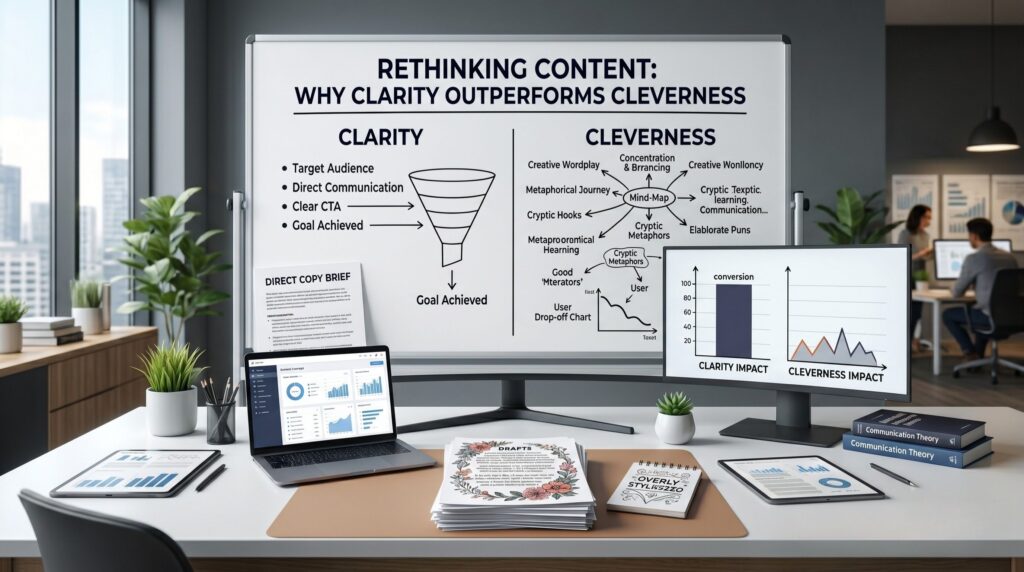

In 2026, publishers that prioritize clarity over cleverness are outperforming those relying on creative but vague messaging. Search engines and AI platforms now reward content that is direct, structured, and easy to interpret. Clear signals improve indexing, strengthen relevance, and increase the chances of being cited in AI-generated answers.
That’s why publishers working with an experienced SEO service provider in Kolkata are focusing less on flashy wording and more on semantic precision, structured formatting, and clear topical intent.
What Does “Clarity Over Cleverness” Mean in SEO?
Clarity over cleverness means writing and structuring content so both users and AI systems can instantly understand what the page is about, why it matters, and how it answers the search query.
Instead of relying on witty headlines or ambiguous messaging, publishers should focus on:
- Direct topic definitions
- Transparent page intent
- Structured information hierarchy
- Clear semantic relationships
This clear content strategy ensures search engines interpret your content correctly and reward it with stronger indexing signals.
Why Clarity Matters More Than Ever in 2026
Traditional SEO focused on ranking pages. Modern AI-driven search focuses on understanding answers.
When a publisher uses vague phrasing, the AI has to “guess” the meaning. That uncertainty weakens the content’s authority and lowers its chance of appearing in AI summaries or featured snippets.
Clear content creates:
- Faster indexing
- Stronger semantic matching
- Higher answer extraction rates
- Better trust signals for AI models
This is particularly important for media brands and publishers that depend on visibility to maintain organic reach.
Definition: What Are Indexing Signals?
Indexing signals are content and technical cues that help search engines determine what a page covers, how important it is, and where it should appear in search results.
These signals include:
- Page structure
- Keyword context
- Internal links
- Schema markup
- Topical consistency
If those signals are inconsistent, even high-quality content may struggle to rank or be cited.
The Core Signals Publishers Need to Strengthen
1. Clear Heading Hierarchy
Search engines use headings to understand page structure. If headings are vague or overly creative, the content meaning becomes diluted.
For example:
- Weak: “The Secret Sauce Behind Great Growth”
- Strong: “How Publishers Improve Organic Traffic with Structured Content”
The second heading sends stronger indexing signals because it clearly defines the topic.
2. Topic-to-Intent Alignment
Every section of a page should support the core user intent. Publishers often lose visibility when they combine unrelated ideas in one article.
Strong intent alignment helps AI identify:
- The main subject
- The supporting concepts
- The user problem being solved
This is why editorial clarity matters just as much as technical SEO.
3. Structured Content Blocks
Lists, definitions, tables, and short paragraphs make it easier for AI systems to extract answers.
Publishers using geo strategy frameworks are structuring content into answer-friendly segments instead of long, unbroken text.
This improves:
- Snippet eligibility
- AI answer visibility
- User comprehension
Step-by-Step: Building Clarity Signals Into Publisher Content
Step 1: Define the Page Purpose
Start by clarifying the exact question your content answers.
If the page purpose is unclear, the indexing signals become weak.
Step 2: Map Semantic Relevance
Identify the primary topic and 3–5 supporting subtopics. Make sure every section reinforces the main theme.
This strengthens semantic SEO and improves topical depth.
Step 3: Format for Extraction
Use definitions, bullet points, and concise answers. AI tools prefer content they can extract quickly and confidently.
Step 4: Strengthen Internal Context
Internal links should connect conceptually related pages, not just target keywords.
That’s where a trusted digital marketing services company in Kolkata can help create a semantic linking structure that boosts discoverability.
Practical Example: Clever vs Clear Publishing
Imagine a publisher writes an article titled:
“The Hidden Formula for Audience Growth”
It sounds engaging, but it lacks clarity.
A clearer version would be:
“Audience Growth Strategies Publishers Can Use to Improve SEO Visibility”
The second version:
- Clarifies intent
- Improves keyword relevance
- Provides stronger indexing signals
In AI-first search, clarity wins every time.
Benefits of a Clear Content Strategy for Publishers
- Better crawling and indexing accuracy
- Higher inclusion in AI-generated answers
- Improved topical authority
- Stronger user engagement metrics
- More sustainable organic traffic growth
Clear content isn’t just easier to read—it’s easier to trust, rank, and recommend.
FAQs
Why is clarity important for publishers in SEO?
Clarity helps search engines and AI tools understand the page topic quickly, improving indexing, rankings, and AI answer inclusion.
What are indexing signals in content SEO?
Indexing signals are structural and contextual cues such as headings, internal links, schema, and topical relevance that guide search engine understanding.
How does clear formatting help AI visibility?
Clear formatting makes it easier for AI systems to extract direct answers, increasing the chance of appearing in AI-generated summaries.
Does clever copywriting hurt SEO?
Not always, but when creativity reduces clarity, it weakens semantic signals and lowers search engine confidence in the page’s relevance.
What is a clear content strategy?
A clear content strategy prioritizes semantic relevance, structured formatting, and direct messaging to improve search visibility and user understanding.
Conclusion
For publishers in 2026, clarity is not a stylistic preference—it’s an SEO necessity. Clever headlines may attract attention, but clear signals drive discoverability. Publishers that simplify structure, sharpen intent, and improve indexing signals will be the ones earning visibility in both search engines and AI-driven platforms.
Blog Development Credits:
This blog was planned by Amlan Maiti, enhanced with AI-powered research tools, and strategically refined by Digital Piloto Private Limited for better search performance.