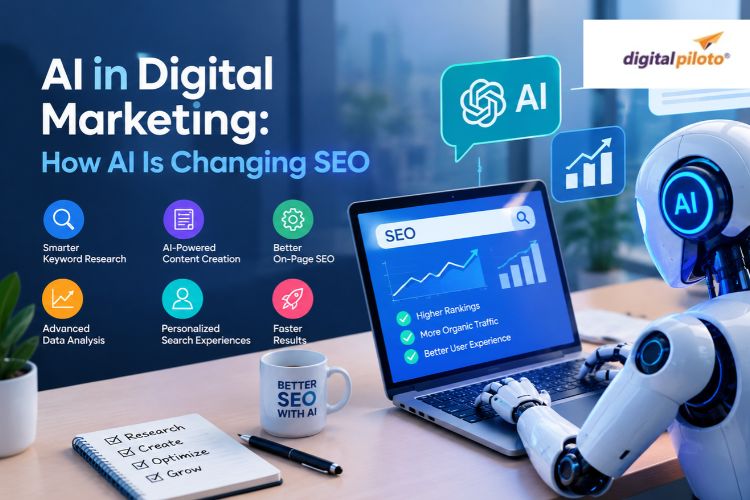

What Is AI in Digital Marketing?
AI in digital marketing refers to using artificial intelligence technologies to analyse information, recognise patterns, automate tasks, generate insights, and support marketing decisions. These technologies include machine learning, natural language processing, predictive analytics, recommendation systems, and generative AI.
Rather than replacing every marketing activity, AI can help teams complete repetitive work more efficiently and make better-informed decisions. Marketers can use AI tools to organise keyword data, identify audience patterns, draft content outlines, analyse campaign performance, and discover potential areas for improvement.
For example, an ecommerce company may use AI to identify products that attract growing interest, while a service-based business may analyse customer enquiries to discover common questions worth addressing through SEO content.
The most effective approach combines AI-powered analysis with human judgement, subject knowledge, creativity, and quality control.
How AI Is Changing SEO in 2026
SEO is evolving as search engines use increasingly sophisticated systems to interpret meaning, understand user intent, and generate AI-powered responses. Google explains that its AI search experiences continue to rely on foundational SEO practices and content from its search index. Google’s guidance on generative AI search emphasises useful, original content and sound technical foundations.
1. Smarter Keyword Research and Search Intent Analysis
Traditional keyword research often begins with search volume, competition, and keyword variations. AI can expand this process by helping marketers group related queries, identify recurring questions, and understand the different intentions behind searches.
For example, someone searching for “SEO services” may be exploring available solutions, while someone searching for “SEO agency pricing” may be closer to making a purchase decision. AI-assisted analysis can help distinguish informational, commercial, and transactional intent.
Marketers can use these insights to organise content into relevant topic clusters and match each page to a specific audience need.
However, AI-generated keyword suggestions still require validation. Search demand, business relevance, competition, and the actual search results should guide final keyword selection.
2. AI-Powered Content Planning and Optimisation
AI tools can help marketers brainstorm article ideas, prepare outlines, identify missing subtopics, and improve the clarity of existing content. They can also help compare a draft against the questions users commonly ask about a subject.
Suppose a business publishes a guide about local SEO. An AI assistant might suggest additional sections covering Google Business Profile optimisation, customer reviews, location pages, and local keyword research.
These suggestions can make the article more comprehensive, but they should not be accepted automatically. The writer must check accuracy, remove repetition, include useful examples, and add original insights that make the content worth reading.
Google’s guidance does not give AI-generated content an automatic ranking advantage. The priority remains content that is helpful, reliable, original, and created for people.
3. Better Understanding of Search Intent
Search engines increasingly use AI to interpret context and the meaning behind a query instead of relying exclusively on exact keyword matches.
This means a page can be relevant to a search even when its wording differs from the exact phrase entered by the user. Content planning should therefore focus on answering the underlying question rather than repeating a target keyword unnecessarily.
For businesses, this approach means developing pages that address customer problems, explain solutions, compare options, and provide the information people need to make decisions.
4. AI Overviews and Generative Search Experiences
AI-powered search experiences can summarise information and provide links to supporting websites. This changes how users discover information and how brands may earn visibility within search results.
Businesses should continue to make their pages accessible to search engines, organise content clearly, and provide accurate information supported by relevant evidence. Original research, practical demonstrations, expert explanations, and first-hand experience can help differentiate a page from generic content.
Appearing in an AI-generated response is not guaranteed, even when a page follows SEO best practices. Therefore, marketers should monitor traditional organic performance alongside any available reporting for AI-powered search features.
5. Technical SEO Analysis and Automation
Technical SEO involves identifying issues that prevent search engines from efficiently crawling, rendering, or indexing important pages. AI-assisted tools can help organise audit findings, identify patterns in large datasets, and prioritise potential problems for further investigation.
Examples of tasks that can benefit from automation include:
- Identifying broken internal links and redirect patterns.
- Grouping pages with similar title tags or meta descriptions.
- Finding pages with thin or duplicated content that require review.
- Analysing crawl reports and identifying recurring technical issues.
- Monitoring changes in keyword rankings and organic traffic.
- Generating initial recommendations for improving website structure.
AI can help identify possible problems, but technical recommendations should be verified before implementation. An automated audit may flag an issue without understanding its business impact or the wider website architecture.
6. Predictive Analytics and SEO Forecasting
Predictive analytics uses historical data and statistical models to estimate possible future outcomes. In digital marketing, it can help identify seasonal trends, changes in customer demand, and patterns in campaign performance.
For SEO teams, this may support content planning, budget allocation, and the prioritisation of pages with growth potential.
However, forecasts are estimates rather than guarantees. Search algorithm changes, competitor activity, market conditions, and website updates can influence actual results. Marketers should use predictions alongside real performance data and professional judgement.
How AI Is Changing Content Creation
Generative AI can assist with several stages of content production, including research organisation, outlining, drafting, editing, summarisation, and repurposing. This can help teams move from an initial idea to a structured draft more efficiently.
For example, a long-form article can be adapted into a newsletter, a social media post, or a set of discussion points for a video. Each version should still be reviewed for accuracy, audience relevance, and the requirements of its specific platform.
AI-assisted content creation works best when human contributors add information that automated systems cannot reliably infer from a prompt alone, such as customer experiences, expert opinions, original data, and business-specific knowledge.
Can AI-Generated Content Rank on Google?
AI-assisted content can appear in search results when it meets Google’s requirements and provides value to users. The use of AI alone does not guarantee good or poor rankings.
The risk arises when businesses mass-produce unoriginal, low-value pages primarily to manipulate rankings. Google’s spam policies address scaled content abuse regardless of whether the material is generated by AI, automation, or human writers.
Before publishing AI-assisted content, verify claims, check sources, remove unsupported statements, and add relevant experience or analysis. The goal should be to help readers, not simply increase the number of indexed pages.
What Is Generative Engine Optimisation (GEO)?
Generative Engine Optimisation, commonly known as GEO, refers to efforts to improve a brand’s visibility in AI-powered search and answer experiences. These may include generative search tools that synthesise information and provide links to sources.
GEO strategies often overlap with established SEO practices. Clear website architecture, crawlable pages, accurate information, relevant internal links, and helpful content all contribute to discoverability.
Businesses exploring generative engine optimization services should look for strategies that focus on genuine visibility and useful content rather than unsupported promises of guaranteed AI citations.
There is no universal formula that guarantees inclusion in every generative search response. Different systems may use different sources, models, and retrieval methods, so results can vary by query and platform.
Benefits of Using AI in Digital Marketing
When applied thoughtfully, AI can support several areas of digital marketing.
Improved Efficiency
AI can reduce the time spent on repetitive tasks such as sorting keywords, classifying content, summarising reports, and preparing initial drafts. This allows marketing teams to spend more time on strategy, customer research, and quality improvement.
Data-Driven Decision-Making
AI-powered analysis can help identify patterns across large datasets that may be difficult to examine manually. Marketers can use these findings to generate hypotheses, test campaigns, and refine their strategies.
More Relevant Customer Experiences
AI can support audience segmentation, product recommendations, and personalised messaging based on available customer data. Personalisation should remain relevant, transparent, and consistent with applicable privacy requirements.
Scalable Marketing Workflows
Automation can help businesses manage multiple campaigns, content assets, and reporting processes. Scalability is most useful when the underlying workflow has clear standards and review procedures.
Faster Performance Analysis
AI-assisted reporting can help teams summarise campaign results, identify unusual changes, and highlight areas for investigation. Human review remains essential before drawing conclusions or making significant budget decisions.
Limitations and Risks of AI in SEO
Despite its benefits, AI is not a substitute for sound marketing judgement. Businesses should understand its limitations before incorporating it into important workflows.
- Incorrect information: AI systems can produce plausible but inaccurate claims, figures, and explanations.
- Generic content: Automatically generated articles may lack original insight and fail to differentiate a brand.
- Search volatility: No AI tool can reliably guarantee rankings or predict every algorithm change.
- Privacy concerns: Uploading customer or confidential business data to external tools can create data protection risks.
- Over-automation: Automated actions can create errors at scale if workflows lack monitoring and safeguards.
- Misleading recommendations: AI tools may suggest tactics that are ineffective, outdated, or inconsistent with search engine guidelines.
A practical solution is to assign AI suitable tasks while retaining human oversight for strategy, verification, publication, and high-impact decisions.
How Businesses Can Use AI for SEO Effectively
Businesses do not need to automate every marketing activity to benefit from AI. A focused implementation plan is often more useful than adopting multiple tools without clear objectives.
Step 1: Define a Clear Business Goal
Determine what you want to improve, such as organic traffic, qualified leads, content production efficiency, or technical SEO monitoring. A specific goal makes it easier to choose appropriate tools and measure results.
Step 2: Audit Your Existing SEO Performance
Review current rankings, organic landing pages, conversion data, indexing status, and technical issues. Establish a baseline before introducing a new workflow so you can assess whether it delivers meaningful improvements.
Step 3: Select Tools Based on the Task
Choose AI tools that address a real operational need. A content team may benefit from research and editing assistance, while a technical SEO team may need tools for log analysis, crawling, or reporting automation.
Step 4: Create a Human Review Process
Set clear standards for factual accuracy, originality, brand voice, privacy, and search policy compliance. Assign responsibility for reviewing AI outputs before they are published or used to make important decisions.
Step 5: Measure and Improve
Track performance against your original goals. Review organic clicks, impressions, qualified leads, conversions, content quality, and time saved. Continue using workflows that deliver measurable value and revise those that do not.
Essential AI and SEO Metrics to Monitor
AI adoption should be evaluated using business outcomes rather than the number of tasks automated or articles published.
- Organic clicks and impressions: Monitor changes in search visibility and visits.
- Search click-through rate: Evaluate how frequently impressions result in clicks.
- Qualified organic leads: Measure whether SEO attracts visitors likely to become customers.
- Conversion rate: Determine whether website visits lead to valuable actions.
- Content quality: Assess accuracy, originality, relevance, and usefulness.
- Workflow efficiency: Compare the time required to complete tasks before and after automation.
- Technical health: Track crawlability, indexation, broken links, and other relevant website issues.
Google Search Console provides useful search performance data, while analytics and CRM platforms can help connect marketing activity to leads and revenue. Use available reporting for AI search features where applicable, and avoid treating third-party estimates as direct access to a search engine’s internal systems.
The Future of AI in Digital Marketing
AI is likely to become more integrated into research, analytics, content workflows, campaign management, and customer interactions. Search experiences will continue to evolve, and businesses will need to adapt as audience behaviour and available tools change.
However, technological progress does not remove the need for useful content, trustworthy information, technical accessibility, and a strong understanding of customers.
Businesses that combine automation with original thinking and responsible oversight will be better positioned to make informed decisions. Instead of chasing every new AI trend, focus on solving customer problems and improving measurable marketing outcomes.
Frequently Asked Questions
1. How is AI changing SEO?
AI is helping marketers analyse keywords, understand search intent, organise content, identify technical issues, and interpret performance data. Search engines also use AI to understand queries and deliver AI-powered search experiences. Traditional SEO fundamentals remain important.
2. Will AI replace SEO professionals?
AI can automate certain tasks, but SEO still requires strategic planning, technical expertise, critical thinking, original content, and an understanding of customer behaviour. AI is best used as a tool that supports skilled professionals rather than a complete replacement.
3. Can AI-generated content rank on Google?
Yes, AI-assisted content can rank if it satisfies users and complies with Google’s policies. Content produced at scale without meaningful originality or value may violate Google’s spam policies, regardless of how it was created.
4. What is the difference between SEO and GEO?
SEO focuses on improving a website’s visibility in search engines. GEO refers to efforts aimed at improving visibility in generative AI search and answer experiences. The practices overlap significantly, and strong SEO foundations remain relevant to Google’s AI-powered search features.
5. Which AI tools are useful for SEO?
Useful tools depend on the task. Marketers may use AI assistants for research and content support, SEO platforms for keyword and competitor analysis, website crawlers for technical audits, and analytics tools for performance measurement. Validate tool outputs before acting on them.
6. Does AI guarantee better SEO rankings?
No. AI can help improve workflows and identify opportunities, but it cannot guarantee rankings, traffic growth, or inclusion in AI-generated responses. Results depend on content quality, technical accessibility, relevance, competition, and many other factors.
7. How can small businesses start using AI in digital marketing?
Begin with a clearly defined task, such as grouping keywords, summarising performance reports, or preparing content outlines. Review the results manually, protect sensitive information, and measure whether the tool saves time or improves business outcomes.
Final Thoughts
AI is changing digital marketing by making research, analysis, content planning, and selected SEO tasks more efficient. It is also reshaping how people discover information through AI-powered search experiences.
Still, effective SEO depends on more than automation. Businesses need helpful content, accurate information, strong technical foundations, and a clear understanding of their audiences. AI can support these efforts, but it should not replace human expertise or responsible decision-making.
For businesses aiming to grow their online visibility, the best approach is to combine proven SEO practices with carefully selected AI tools, continuous measurement, and a commitment to delivering genuine value to customers.
Author: Amlan Maiti, Founder & Director at Digital Piloto Pvt. Ltd. | Connect on LinkedIn
SEO Credits: Digital Piloto SEO, GEO & Digital Marketing Team