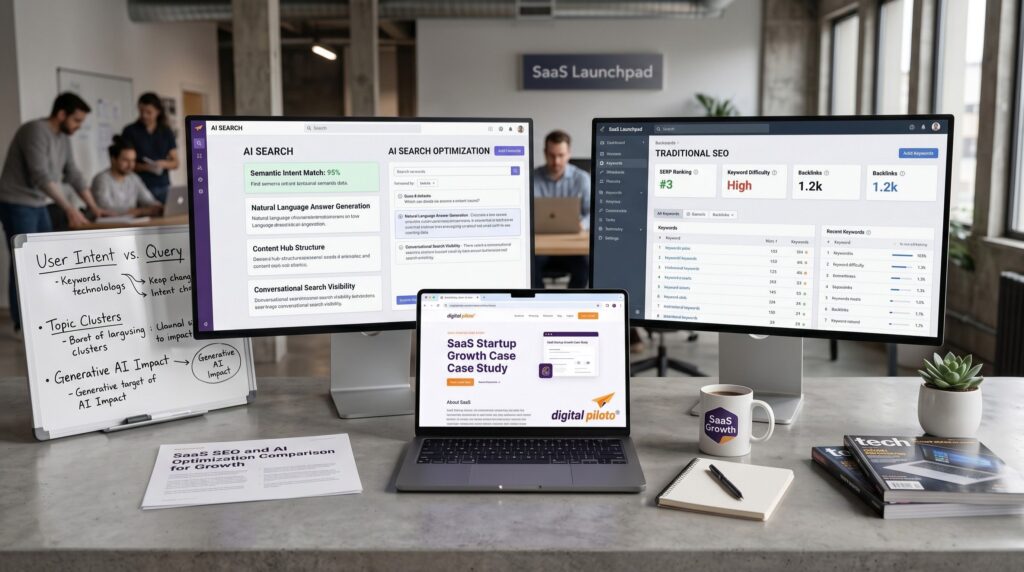

For SaaS companies, the right approach isn’t choosing between AI search and traditional SEO—it’s learning how to combine both into a unified growth system. AI search determines whether your product is recommended or summarized, while SEO ensures discoverability and traffic. A modern SaaS strategy must align content, intent, and machine-level trust to win visibility across both layers.
Many SaaS brands still rely only on keyword rankings, which limits their reach in AI-driven discovery. Leveraging expert SEO services in Kolkata can help transition from traffic-focused SEO to a broader, AI-aware visibility model.
What is AI Search vs Traditional SEO?
Definition (Clear & Extractable)
AI Search refers to AI-powered systems that generate direct answers, product recommendations, and summaries based on user intent and context.
Traditional SEO focuses on optimizing web pages to rank in search engine results using keywords, backlinks, and technical improvements.
In SaaS terms: SEO gets users to your site, while AI search decides if your product is mentioned before they even click.
Why SaaS Companies Must Adapt Now
SaaS buyers don’t just search—they ask questions, compare tools, and expect quick answers. AI search platforms fulfill this behavior by summarizing options instantly.
This creates a new challenge: if your SaaS product isn’t included in those summaries, you lose visibility—even if you rank well.
- Decision-making is faster: AI compresses research into seconds
- Fewer clicks: Users rely on answers, not links
- Higher competition: Only a few brands get mentioned
This is where the real battle of ai search vs SEO plays out.
Key Differences That Matter for SaaS
Bullet Explanation Format
- SEO: Drives organic traffic
AI Search: Drives brand inclusion in answers - SEO: Keyword targeting
AI Search: Intent and context understanding - SEO: Page-level optimization
AI Search: Product-level and entity-level clarity - SEO: Click-based success
AI Search: Mention-based influence
SaaS companies must optimize for both—because traffic without trust doesn’t convert, and mentions without presence don’t scale.
Step-by-Step Tutorial: SaaS Strategy for AI Search + SEO
Step 1: Map Core User Intent
Identify what your target users ask at each stage—awareness, comparison, and decision.
Step 2: Build Structured Content
Create pages that clearly answer questions, define features, and explain use cases in simple terms.
Step 3: Optimize for Entity Clarity
Ensure your product, features, and integrations are consistently defined across your site and external platforms.
Step 4: Create Comparison Content
AI systems often pull from comparison pages. Make sure your product is included in “X vs Y” and “best tools” content.
Step 5: Strengthen Machine-Level Trust
Consistency across reviews, mentions, and content builds machine-level trust, increasing your chances of being recommended.
Step 6: Track AI Visibility
Monitor how often your brand appears in AI-generated answers—not just rankings and traffic.
Content Strategy That Works for SaaS
Content is still the foundation—but the format has changed.
- Answer-focused pages: Clear, direct responses to user queries
- Use-case content: Real-world applications of your SaaS
- Feature breakdowns: Structured explanations of capabilities
Partnering with a generative AI SEO agency helps SaaS brands create content that works for both humans and AI systems.
Common Mistakes SaaS Brands Make
- Over-focusing on keywords: Ignoring intent and context
- Lack of differentiation: Generic content that AI ignores
- Inconsistent messaging: Confusing signals across platforms
- No AI visibility tracking: Missing the bigger picture
Even some of the best digital marketing agencies in Kolkata now prioritize AI visibility alongside traditional SEO metrics.
Real SaaS Example: Visibility Shift
A SaaS analytics company noticed stable rankings but declining sign-ups. The issue wasn’t traffic—it was visibility in AI recommendations.
They adjusted their strategy by:
- Creating structured comparison pages
- Improving product clarity across content
- Aligning messaging across platforms
Within weeks, their product started appearing in AI-generated tool recommendations—leading to higher-quality leads.
Metrics SaaS Teams Should Track
- AI mentions: Frequency of inclusion in AI answers
- Query coverage: Number of relevant questions answered
- Conversion quality: Lead intent and readiness
- Engagement signals: Time on page and interaction depth
Traditional metrics alone don’t capture the full picture anymore.
FAQs: AI Search vs SEO for SaaS
1. Is AI search replacing SEO for SaaS?
No, AI search complements SEO. Both are necessary for complete visibility.
2. What is the biggest change for SaaS marketing?
The shift from keyword rankings to AI-driven recommendations and summaries.
3. How can SaaS products appear in AI answers?
By creating structured, clear, and authoritative content that AI systems can easily interpret.
4. What is machine-level trust in SaaS?
It’s the consistency and reliability of your product signals across platforms that AI systems use to evaluate credibility.
5. How long does it take to see results?
Initial improvements can appear within weeks, but full impact depends on consistency and strategy.
Conclusion
The future of SaaS visibility isn’t about ranking higher—it’s about being chosen by AI. Brands that align SEO with AI search today will dominate tomorrow’s buying journeys. The opportunity is clear; execution is what separates leaders from the rest.
Blog Development Credits:
This blog draws from the strategic vision of Amlan Maiti, developed using advanced AI tools, and refined with expert insights from Digital Piloto Private Limited.