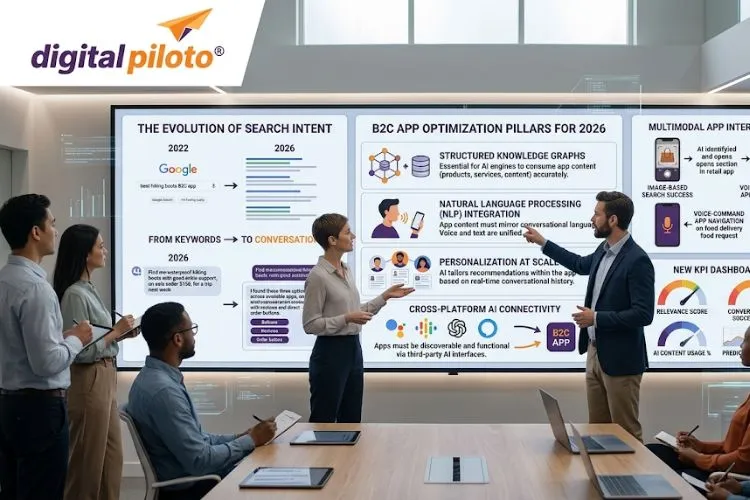

Search, as we knew it, is quietly dissolving. In 2026, users aren’t just typing queries—they’re having conversations with AI. For B2C apps, this shift isn’t subtle; it’s structural. The real question is: are you still optimizing for clicks, or for answers?
The evolution of AI-driven discovery is forcing brands to rethink visibility. A forward-thinking Kolkata Digital Marketing Company today isn’t just chasing rankings—it’s engineering presence inside AI-generated responses.
What Exactly Is the AI Search Shift?
AI search replaces traditional blue links with synthesized answers. Instead of showing ten results, engines now interpret intent, aggregate sources, and deliver a single, contextual response. Think of it as moving from a “search engine” to a “decision engine.”
According to a Pew Research study, users increasingly expect direct answers rather than multiple links. This expectation has accelerated with generative AI interfaces.
Key Differences from Traditional SEO
- From keywords to intent: AI prioritizes meaning, not just matching phrases.
- From rankings to mentions: Visibility now depends on being cited in AI responses.
- From traffic to trust: Authority signals outweigh sheer volume of content.
Why B2C Apps Are Feeling the Heat
B2C apps rely heavily on discovery—whether it’s shopping, food delivery, or fitness. But AI search reduces the need to “browse.” Users often get recommendations without ever opening an app.
This creates a paradox: better user experience globally, but fewer direct touchpoints for brands.
Common Challenges B2C Apps Face
- Reduced organic traffic: AI answers eliminate clicks.
- Loss of brand recall: Users trust AI summaries over individual brands.
- Data dependency: Structured, high-quality data becomes non-negotiable.
Interestingly, many companies featured in a typical Kolkata Software Company List are already adapting their platforms to become AI-readable rather than just user-friendly.
The New Playbook: Optimizing for AI Discovery
Let’s be honest—traditional SEO alone won’t cut it anymore. B2C apps need a hybrid strategy blending technical clarity with contextual authority.
1. Build Entity-Level Clarity
AI models understand “entities” (people, brands, products) better than pages. Ensure your app content clearly defines what you are, what you offer, and how you differ.
2. Prioritize Structured Data
Schema markup isn’t optional anymore. It’s how AI interprets your content. Product details, reviews, FAQs—all must be machine-readable.
3. Create Answer-First Content
- Write content that directly answers user questions
- Use conversational phrasing
- Include real-world examples and scenarios
This is where partnering with a generative engine optimization agency can give brands an edge—by aligning content with how AI systems actually generate responses.
Metrics That Actually Matter Now
Let’s drop the vanity metrics. In AI search, success looks different.
- AI citations: How often your brand appears in generated answers
- Query coverage: The breadth of intent your content satisfies
- Engagement depth: Quality of user interaction post-discovery
A McKinsey report suggests that AI-driven interfaces could influence over 40% of digital interactions by 2026, making these metrics critical.
Real-World Example: A Food Delivery App
Imagine a user asking, “What’s the best late-night food option near me?”
In 2022, they’d browse multiple apps. In 2026, AI suggests a curated answer—possibly naming one app, one restaurant, one dish.
If your app isn’t part of that answer, you simply don’t exist in that moment.
FAQs
Q. What is AI search optimization for B2C apps?
A. It’s the process of making your app’s content and data easily interpretable by AI systems so they can feature your brand in generated answers, not just search results.
Q. Does traditional SEO still matter in 2026?
A. Yes, but it’s evolving. Technical SEO and content quality remain important, but they must align with AI-driven intent understanding and structured data.
Q. How can B2C apps measure success in AI search?
A. Focus on AI mentions, visibility in conversational queries, and user engagement after discovery rather than just traffic or rankings.
Q. Is AI search reducing website traffic?
A. In many cases, yes. However, it also improves lead quality by connecting users directly with relevant solutions.
Final Thoughts
The AI search shift isn’t a trend—it’s a reset. For B2C apps, the challenge isn’t just visibility anymore; it’s relevance within AI-driven conversations. Brands that adapt early will shape how they’re represented. Those that don’t? They risk becoming invisible, even if they rank.
Blog Development Credits:
This article was conceptualized and authored by Amlan Maiti, developed with the assistance of advanced AI tools including ChatGPT, Gemini, and Copilot, and strategically reviewed and refined by the SEO specialists at Digital Piloto Private Limited.