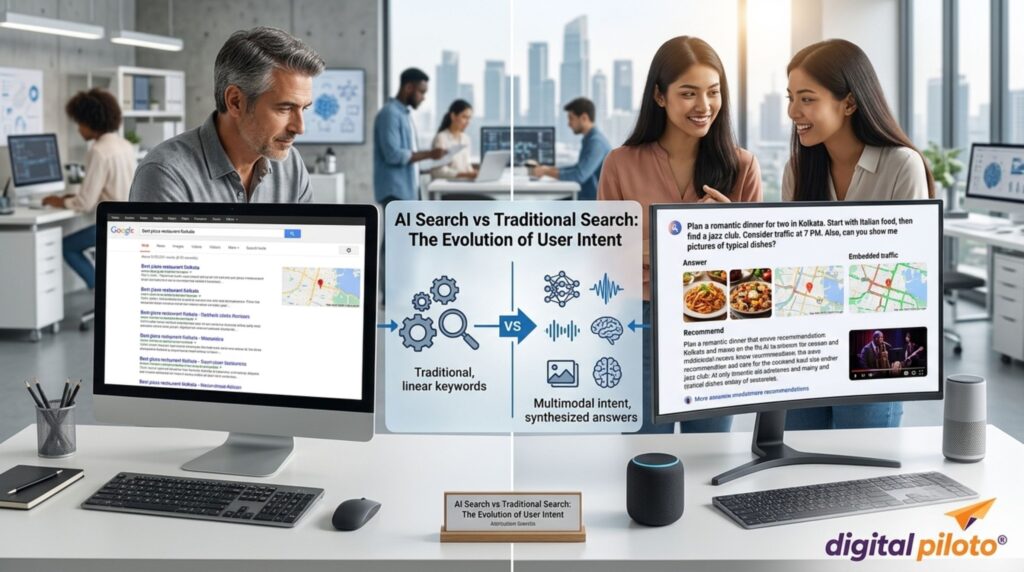

AI search has changed user intent from simple keyword queries into richer, context-driven conversations. Traditional search often matches words to pages, while AI search interprets goals, context, constraints, and follow-up questions. For brands, this means visibility now depends not only on ranking for keywords, but on becoming a credible answer within a user’s decision-making journey.
That shift has major implications for any digital marketing agency working on organic visibility. The fundamental question is no longer simply, “What keyword should we rank for?” It is increasingly, “What is the user actually trying to accomplish?”
What Is User Intent in Traditional Search?
Traditional search intent is the underlying purpose behind a query entered into a search engine. SEO typically groups intent into categories such as informational, navigational, commercial, and transactional.
For example, a person searching “best laptops under ₹70,000” has a commercial investigation intent. Someone searching “buy Dell laptop online” is much closer to a transaction.
Search engines have become remarkably good at interpreting these signals, but the interaction still tends to begin with a relatively compact query. The user searches, reviews results, opens pages, compares information, and searches again.
Traditional search intent usually follows this pattern:
- Query: The user enters a specific keyword or phrase.
- SERP: The search engine presents relevant pages, ads, maps, videos, or snippets.
- Evaluation: The user compares several results.
- Action: The user clicks, visits, purchases, contacts, or searches again.
This model created the foundation for keyword research and conventional SEO. But AI search is changing the interaction itself.
How Does AI Search Interpret User Intent Differently?
AI search interprets intent as a broader context rather than treating every query as an isolated keyword event. It can consider the wording of the current question, previous conversational context, implied constraints, and the user’s likely objective.
Consider the difference between these two interactions:
Traditional: “best CRM for small business”
AI search: “I run a 10-person B2B company, have a limited sales team, need WhatsApp integration, and want a CRM that can scale. Which options should I consider?”
The second query contains considerably more decision-making information. The user is not merely looking for a list. They are asking the system to interpret a situation and narrow the choices.
That is the real evolution of user intent: from keyword intent to contextual decision intent.
Definition: What Is Contextual User Intent?
Contextual user intent is the combination of a user’s immediate query, underlying objective, constraints, previous context, and expected outcome. AI search uses these signals to produce an answer designed around the user’s situation rather than simply matching a phrase to a webpage.
This matters because two people can type almost identical queries while having completely different goals.
- A startup may want the cheapest software that works.
- A growing company may prioritize scalability and integrations.
- An enterprise may care more about security, governance, and implementation support.
A keyword alone rarely communicates those distinctions. Context does.
Why AI Search Creates Deeper Search Journeys
Traditional search often forces users to construct the journey themselves. They perform multiple searches and connect the information manually.
AI search compresses parts of that process into a conversation. A user can ask a broad question, challenge the answer, add a constraint, request alternatives, and ask for a recommendation without starting over.
A typical AI-driven journey looks like this:
- Discovery: “What are the best options for my problem?”
- Context: “Which ones work for a small B2B company?”
- Comparison: “Compare pricing, features, and implementation difficulty.”
- Validation: “What are the drawbacks of each option?”
- Decision: “Which one would you choose for my situation?”
The important point is that intent evolves during the interaction. A user can move from informational to commercial intent without changing platforms.
Traditional Search vs AI Search: The Practical Difference
| Traditional Search | AI Search |
|---|---|
| Keyword-led | Context-led |
| One query at a time | Continuous conversation |
| Multiple results to evaluate | Synthesized answers and recommendations |
| User connects information | AI can connect related information |
| Ranking is highly visible | Brand mentions and citations may be more important |
| Intent is often inferred from keywords | Intent can be refined through conversation |
This does not mean traditional SEO is becoming irrelevant. Search engines still depend heavily on websites, structured information, authority, and discoverability. The change is that the definition of visibility is becoming broader.
How Brands Should Optimize for Evolving Intent
Brands should stop treating content as a collection of pages built around isolated keywords. Instead, content should map to the questions and decisions customers make throughout a topic.
Step-by-step approach
- Identify the real customer problem. Go beyond search volume and understand what users are trying to solve.
- Map the decision journey. Document the questions users ask before, during, and after considering a product or service.
- Create answer-focused content. Give direct definitions, comparisons, examples, processes, and evidence.
- Strengthen entity clarity. Clearly explain what the brand does, who it serves, where it operates, and what differentiates it.
- Support claims with evidence. Use original research, demonstrations, customer examples, expert insights, and transparent information wherever possible.
This is where best SEO services Kolkata can evolve beyond conventional ranking tactics and focus on building durable search visibility across multiple discovery environments.
What Does This Mean for SEO and PPC?
The evolution of intent also changes the relationship between organic and paid search. When users become more specific and commercially aware, campaigns need to reflect those increasingly detailed needs.
For example, a generic advertisement for “digital marketing services” may attract broad interest. A campaign addressing “B2B SaaS lead generation for companies entering the Indian market” speaks to a much more defined intent.
This is why the best PPC company in Kolkata should think beyond keywords and examine the problem, audience, stage of consideration, and expected action behind every search.
AI Search Rewards Relevance, Not Just Repetition
One of the biggest strategic mistakes brands can make is assuming that repeating a target keyword will make content more useful to AI systems.
It will not.
Useful content demonstrates relationships between concepts. It explains why something matters, when it applies, where it falls short, and what the reader should do next.
For example, a page about “CRM software” becomes considerably stronger when it explains suitable business sizes, implementation requirements, common limitations, pricing considerations, integrations, and use cases.
That depth gives both humans and AI systems more meaningful information to work with.
FAQs About AI Search and User Intent
1. What is the main difference between AI search and traditional search?
Traditional search primarily matches queries with relevant results, while AI search can interpret context, combine information, and maintain conversational intent across multiple questions.
2. Is keyword research still important for AI search?
Yes. Keywords remain useful for understanding language and demand, but brands should also analyze questions, problems, entities, comparisons, and conversational variations surrounding those keywords.
3. Does AI search make traditional SEO obsolete?
No. Technical SEO, authority, useful content, crawlability, and structured information remain important. AI search expands SEO rather than simply replacing it.
4. How can businesses optimize for AI-driven search?
Build authoritative, well-structured content that directly answers customer questions, demonstrates expertise, provides evidence, and clearly communicates the brand’s products, services, and expertise.
5. Why is context becoming more important in search?
Context helps systems understand the difference between a general information request and a specific decision. It allows search experiences to become more personalized and useful.
Conclusion
The evolution from traditional search to AI search is ultimately an evolution in how people express intent. Users are moving from short keyword queries toward conversations that reveal their goals, constraints, preferences, and expectations.
For marketers, the lesson is straightforward: optimize for the question behind the keyword. The brands that understand what people are genuinely trying to accomplish will be better positioned to remain visible—whether the answer appears in a traditional SERP, an AI-generated response, or the next search experience we have yet to adopt.
Blog Development Credits
This blog was conceptualized by Amlan Maiti, researched with advanced AI tools, and finally optimized for SEO by Digital Piloto Private Limited.