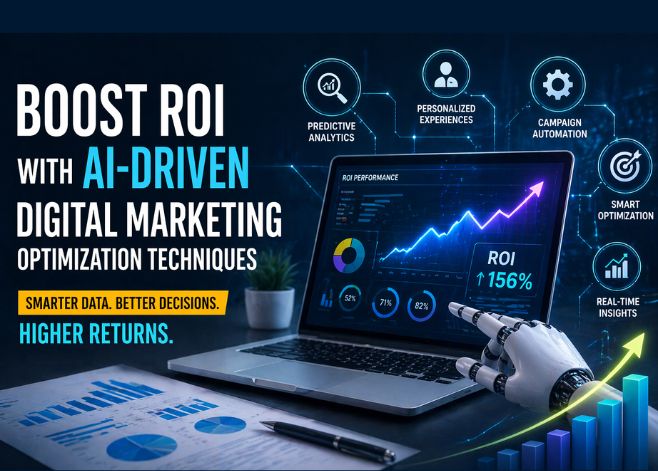

What if your marketing campaigns could almost “think” for themselves—adjusting, learning, and improving in real time? That’s not a futuristic idea anymore; it’s happening right now. Businesses are increasingly turning to Digital Marketing Optimization AI to stretch every rupee further and generate measurable, consistent returns on investment.
But here’s the catch—AI isn’t magic. It’s a tool, and like any tool, its effectiveness depends on how you use it. Let’s break down how AI-driven digital marketing optimization actually boosts ROI and what techniques are worth your attention today.
Why AI is Changing the ROI Game
Traditional marketing often relies on assumptions, historical data, and a bit of guesswork. AI flips that approach entirely. Instead of waiting weeks to analyze campaign performance, AI tools process massive datasets instantly and suggest real-time adjustments.
According to a report by McKinsey & Company, companies using AI in marketing have seen revenue increases of up to 20% in certain segments. That’s not just marginal growth—it’s a significant competitive advantage.
Also Read: User Satisfaction Rates in Retail: A Guide You Can’t Miss
Key AI-Driven Optimization Techniques
1. Predictive Analytics for Smarter Decisions
Predictive analytics is where AI really shines. It studies past user behavior to forecast future actions—like which users are likely to convert or which products will trend next.
- Audience targeting: Focus on users most likely to engage
- Budget allocation: Invest where returns are highest
- Campaign timing: Launch ads when users are most active
It’s a bit like having a seasoned marketer whispering insights in your ear—except this one works 24/7 without coffee breaks.
2. Personalized Customer Experiences
Let’s be honest—generic marketing doesn’t cut it anymore. People expect brands to “get” them. AI helps deliver hyper-personalized experiences by analyzing browsing habits, purchase history, and engagement patterns.
- Dynamic website content tailored to user preferences
- Email campaigns that adapt based on behavior
- Product recommendations that feel intuitive
Interestingly, research from Salesforce suggests that 73% of customers expect companies to understand their unique needs. AI makes that expectation achievable at scale.
3. Automated Campaign Optimization
One of the most practical benefits of AI is automation. Instead of manually tweaking campaigns, AI tools continuously monitor performance and make adjustments on the fly.
- Bid adjustments: Maximize ad efficiency in real time
- A/B testing: Instantly identify winning creatives
- Performance tracking: Detect underperforming ads early
This is where ROI truly improves—because wasted spend is minimized without constant human intervention.
The Role of Strong Digital Infrastructure
Here’s something many businesses overlook: AI works best when your digital foundation is solid. A slow website or poor UX can sabotage even the smartest campaigns.
That’s why partnering with a reliable Web Development Company in Kolkata can make a noticeable difference. From faster load times to seamless user journeys, a well-built website ensures that AI-driven traffic actually converts.
Common Mistakes to Avoid
AI can be powerful, but misusing it can lead to wasted budgets and poor results. Here are a few pitfalls to watch out for:
- Over-reliance on automation: Human strategy still matters
- Poor data quality: AI is only as good as the data it analyzes
- Ignoring user experience: Technology can’t fix bad design
Think of AI as a co-pilot—not the entire flight crew.
Future Trends in AI Marketing Optimization
The future of AI in digital marketing is both exciting and slightly unpredictable. Voice search, visual recognition, and AI-generated content are already shaping how brands interact with audiences.
A study by Statista indicates that global AI marketing revenue is expected to grow significantly over the next decade, reflecting its increasing adoption across industries.
Businesses that adapt early often gain the upper hand—not just in efficiency, but in creativity and customer engagement as well.
FAQs
Q1. How does AI improve marketing ROI?
AI improves ROI by analyzing data in real time, optimizing campaigns automatically, and targeting high-conversion audiences more accurately.
Q2. Is AI suitable for small businesses?
Yes, many AI tools are scalable and affordable, making them accessible even for startups and small businesses looking to optimize marketing efforts.
Q3. Do I need technical expertise to use AI in marketing?
Not necessarily. Many platforms offer user-friendly interfaces, though a basic understanding of marketing strategy is still essential.
Q4. Can AI replace human marketers?
No, AI enhances human capabilities but doesn’t replace creativity, strategy, or emotional intelligence in marketing.
Final Thoughts
AI-driven digital marketing optimization isn’t about replacing human effort—it’s about amplifying it. When used thoughtfully, it helps businesses make smarter decisions, reduce waste, and create meaningful customer experiences. In a world where every click counts, leveraging AI might just be the smartest move you make for long-term growth.
Also Read: Why Your Business Needs a Generative Engine Optimization
Blog Development Credits:
This article idea was originally shaped by Amlan Maiti. It was researched and drafted using AI platforms such as ChatGPT, Gemini, and Copilot, and later refined with SEO insights from Digital Piloto Private Limited.