
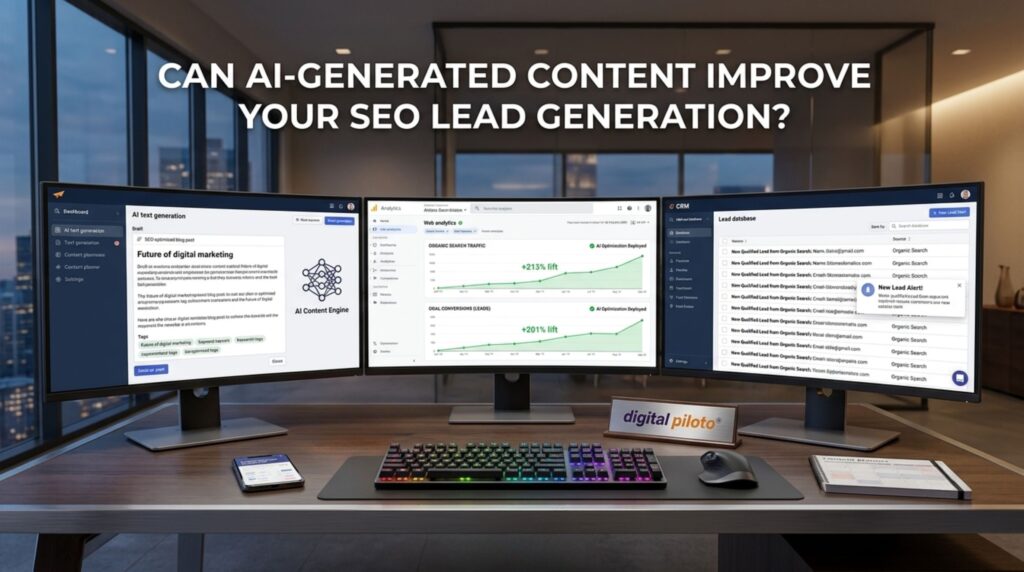

AI can now produce a blog post in minutes, but producing a lead is a different challenge altogether. Searchers still need a reason to trust a business, solve a problem, and take action. So the real question is not whether AI can create more content, but whether it can help create the right content for the right prospect at the right moment.
For businesses investing in digital marketing service India, that distinction is becoming increasingly important. AI can accelerate research, content planning, personalization, and optimization, but SEO lead generation still depends on something machines cannot manufacture on their own: useful information backed by genuine expertise and a compelling reason to act.
AI Content Is Not the Same as AI-Driven SEO
There is a temptation to think of AI content as a simple production shortcut.
Enter a topic. Generate an article. Add keywords. Publish. Wait for leads.
If only marketing worked that way.
AI-generated content can certainly make the production process faster. It can help turn research notes into an outline, identify questions customers may ask, suggest content angles, summarize large datasets, and create an initial draft. But none of those capabilities automatically make a page valuable.
Google’s current guidance is fairly clear on this point. Generative AI can be useful for research and structuring original content, but creating large numbers of pages with little or no added value can fall under its scaled content abuse policy. Google’s focus remains accuracy, quality, relevance, and content created primarily for people.
That gives marketers a useful distinction:
AI can assist content production. It should not replace content strategy.
Why SEO Lead Generation Needs More Than Traffic
Suppose an article receives 10,000 organic visits but generates only two enquiries.
Now imagine another article receives 800 visits and produces 25 highly relevant leads.
Which page created more business value?
The answer seems obvious, yet SEO reporting often puts disproportionate attention on rankings, impressions, and traffic. Those metrics matter, but lead generation happens further down the funnel.
A visitor becomes a potential lead when the content connects their problem with a credible solution.
That means effective SEO lead generation needs to answer several questions at once:
- Does the page attract people with relevant search intent?
- Does it demonstrate enough expertise to earn trust?
- Does it address the reader’s actual problem?
- Does it make the next step obvious without becoming pushy?
- Does the resulting lead have genuine commercial value?
AI can help with many of these tasks. But the strategy has to begin with the customer, not the content generator.
AI Can Make Keyword Research More Intelligent
One of the most practical uses of AI in SEO is expanding the understanding of search intent.
Traditional keyword research might tell you that people search for “CRM software,” “CRM pricing,” or “best CRM for small business.”
AI can help marketers go one step deeper and model the questions behind those searches.
For example, a potential buyer might really be wondering:
- Which CRM is simple enough for a small sales team?
- Can it integrate with WhatsApp?
- Will switching from spreadsheets be difficult?
- How much will implementation cost?
- Can the sales team actually use it without extensive training?
These are not merely keyword variations. They represent different stages of decision-making.
An AI-assisted content strategy can organize these questions into awareness, consideration, comparison, and conversion themes. That creates a much stronger foundation for an SEO lead generation strategy than simply generating dozens of pages around related phrases.
Think in customer questions, not keyword lists
A useful workflow is to combine keyword data with real-world evidence from sales calls, customer support tickets, reviews, website searches, CRM notes, and frequently asked questions.
AI can then help categorize those inputs.
The human team still decides which insights are strategically important.
AI Can Help Build Content for Different Buying Stages
Not every searcher wants to buy immediately.
Someone searching “what is technical SEO?” is probably in a different mindset from someone searching “technical SEO consultant for ecommerce website.” Treating both users with the same content would be like offering a sales contract to someone who has just walked into a showroom to browse.
AI can help map content to different stages of intent.
- Awareness: Explain the problem clearly and help the reader understand what is happening.
- Education: Explore causes, options, terminology, and possible solutions.
- Evaluation: Compare approaches, services, tools, or providers.
- Decision: Address objections, costs, implementation questions, and expected outcomes.
- Action: Provide a relevant next step such as a consultation, demo, audit, quote, or purchase.
This structure helps prevent a common SEO mistake: sending every visitor to the same generic service page regardless of intent.
Personalization Can Make AI Content More Useful
One of AI’s biggest advantages is its ability to work with variations.
A B2B software company, for example, might need separate messaging for startup founders, operations managers, enterprise buyers, and technical decision-makers. The core product remains the same, but their concerns are different.
AI can help marketers identify those differences and create content frameworks for each audience.
That does not necessarily mean generating four nearly identical landing pages. Sometimes one strong resource with clearly separated sections is better. In other situations, genuinely distinct audience pages may make sense.
The decision should come from user needs.
HubSpot’s 2026 State of Marketing research found that 93.2% of surveyed marketers said personalized or segmented experiences had led to more leads or purchases. The same research reported that 80% of marketers were using AI for content creation.
The important connection is not “AI equals personalization.” It is that AI can make useful personalization more practical at scale—provided the underlying audience data and strategy are sound.
Where AI Content Can Actually Improve Lead Generation
AI becomes particularly valuable when it improves the quality of the content workflow rather than merely increasing output.
Consider a typical B2B website. A small marketing team may know that customers repeatedly ask about pricing, implementation time, integrations, security, ROI, and post-sale support. Creating comprehensive content around every meaningful question takes time.
AI can help turn scattered knowledge into an organized editorial system.
High-value applications include:
- Topic discovery: Finding unanswered customer questions and content gaps.
- Content briefs: Structuring articles around intent, entities, questions, and evidence.
- Content repurposing: Turning webinars, interviews, research, and reports into useful formats.
- Personalization: Adapting messaging for legitimate audience segments.
- Internal linking: Identifying relationships between relevant pages and topics.
- Content refreshes: Finding outdated claims, missing sections, and opportunities to improve usefulness.
Notice what is missing from that list: “publish 500 articles automatically.”
Volume is easy. Relevance is harder.
Google’s Position on AI Content Matters
For marketers wondering whether Google automatically penalizes AI-generated content, the answer requires some nuance.
Google’s published guidance says its systems focus on the quality and usefulness of content rather than simply whether AI was involved in its production. However, using automation primarily to manipulate search rankings violates Google’s spam policies.
Its current documentation goes further by emphasizing original, valuable, people-first content. Google specifically recommends adding unique perspectives, firsthand experience, reliable information, and meaningful value instead of simply recycling material already available elsewhere.
So the strategic question should not be:
“Can I publish AI-written content?”
It should be:
“What can I create with AI assistance that is genuinely more useful than what already exists?”
That is a much harder question—and a much better one.
Human Expertise Is the Missing Ingredient
Imagine two articles about diagnosing a slow ecommerce website.
The first summarizes common reasons: large images, poor hosting, excessive JavaScript, plugins, and caching issues.
The second explains how an experienced SEO team discovered that a client’s biggest performance problem was not the obvious image issue but a chain of third-party scripts loading before the primary content. It explains what was tested, what changed, what improved, and what did not.
The second article has something AI can struggle to invent responsibly: real experience.
That is why expert review matters.
AI can produce a polished sentence very quickly. It cannot independently know what happened during a specific client project unless that information is provided to it. Without human input, the result can sound confident while remaining surprisingly generic.
Google’s people-first guidance encourages creators to demonstrate firsthand expertise and provide original information, research, analysis, or meaningful added value.
For SEO lead generation, that expertise also improves conversion. Prospects are not simply buying information. They are deciding whether a company understands their problem.
AI Content and the Rise of AI Search
There is another reason the quality question matters: people increasingly encounter content through AI-generated search experiences.
Google’s current guidance for generative search says established SEO practices remain foundational because AI features use Google’s existing Search systems and retrieved web content. Google also recommends unique, non-commodity information and says there are no special “GEO hacks” required to appear in its AI features.
This means AI-generated content has to compete in a different environment.
If ten websites publish essentially the same AI-written explanation, there is little reason for a search system—or a human reader—to regard any one of them as particularly distinctive.
Original research, expert commentary, firsthand examples, useful frameworks, proprietary data, and clear explanations become much more valuable.
This is where an generative engine optimization agency can contribute strategically: not by promising guaranteed AI citations, but by helping businesses make their information clearer, more useful, authoritative, and discoverable across evolving search environments.
The Biggest Risk: Publishing More Than You Can Maintain
AI makes content creation faster. That can be both an advantage and a trap.
A company may start with ten useful articles and gradually turn its blog into hundreds of pages covering every imaginable keyword variation. Six months later, nobody knows which pages matter, several overlap, old claims remain live, and the site has become harder to manage.
That is not content marketing. It is digital clutter.
Google explicitly warns against producing large volumes of content primarily to manipulate Search, including using generative AI to create many pages without adding value.
A better approach is to use AI for scale where scale genuinely helps—and humans for judgment.
A Practical AI-Powered SEO Lead Generation Framework
Businesses do not need an elaborate AI stack to start. A disciplined workflow is often more valuable than a collection of tools.
- Collect real customer language: Gather questions from sales, support, reviews, forums, surveys, and CRM records.
- Identify commercial intent: Separate educational searches from questions that signal evaluation or purchase readiness.
- Create strategic briefs: Use AI to organize topics, questions, entities, related concepts, and content gaps.
- Add human expertise: Include expert examples, opinions, lessons learned, original data, and practical observations.
- Build conversion paths: Connect informational content to relevant service pages, tools, consultations, downloads, or other useful actions.
- Review performance: Measure qualified leads, conversion rates, lead quality, assisted conversions, and revenue—not just traffic.
This workflow turns AI from a content factory into a research and productivity layer.
What Should You Measure?
If the objective is lead generation, success should eventually show up in the pipeline.
That means an article receiving 20,000 visits is not automatically more successful than one receiving 2,000 visits. The smaller article may attract exactly the people who need the company’s services.
Useful metrics include:
- Organic leads and marketing-qualified leads.
- Lead-to-customer conversion rate.
- Conversion rate by landing page and topic cluster.
- Cost per qualified organic lead.
- Branded search growth.
- Assisted conversions from content.
- Revenue influenced by organic discovery.
HubSpot’s 2026 marketing research lists lead quality and MQLs among the most important metrics marketers use, alongside lead-to-customer conversion rate, ROI, customer acquisition cost, and lead volume.
That is a useful reminder: the purpose of SEO is not to collect visitors. It is to create valuable opportunities.
Where an SEO Team Still Makes the Difference
AI can accelerate execution, but strategic SEO still requires judgment.
An experienced SEO agency India needs to decide which topics deserve investment, which pages should be consolidated, where search intent has changed, which leads are valuable, and where the website is failing to convert otherwise relevant traffic.
It also needs to recognize when AI is producing something technically polished but strategically weak.
That distinction is becoming more important as content production becomes cheaper.
When everyone can produce an acceptable first draft, the competitive advantage shifts toward research quality, positioning, expertise, editing, original thinking, and distribution.
The Future Is AI-Assisted, Not AI-Only
The most sensible model for SEO lead generation is neither “humans do everything” nor “AI does everything.” It is a division of strengths.
AI is excellent at processing information, spotting patterns, organizing ideas, generating alternatives, summarizing large datasets, and accelerating repetitive work.
Humans remain essential for judgment, experience, empathy, originality, accountability, brand voice, and understanding what a prospect actually cares about.
HubSpot’s 2026 research reflects this hybrid direction. Its survey found that 86.4% of marketing teams were using AI in at least some marketing activities, while 73.4% of marketers said they viewed AI as working alongside marketers rather than replacing most of their work.
That may be the most realistic future of content marketing.
AI writes faster. Humans decide what is worth saying.
Frequently Asked Questions
1. Can AI-generated content improve SEO rankings?
AI assistance can support SEO when it helps create accurate, useful, original, people-first content. However, simply generating large quantities of AI content does not guarantee rankings. Google evaluates the usefulness and quality of the resulting content rather than rewarding AI generation itself.
2. Can AI-generated content generate qualified leads?
Yes, when it addresses genuine customer problems and connects relevant search intent with a useful conversion path. The strongest results usually come from AI-assisted research and production combined with human expertise, editing, and strategic optimization.
3. Does Google penalize all AI-generated content?
No. Google’s guidance says the use of AI or automation is not inherently against its policies. The problem arises when automation is used primarily to manipulate rankings or create large volumes of low-value, unoriginal content.
4. How should businesses use AI for SEO content?
Use AI for research, ideation, outlines, content analysis, personalization, optimization, and repetitive tasks. Add human expertise, original evidence, firsthand experience, careful fact-checking, and strategic conversion paths before publishing.
Final Thoughts
AI-generated content can improve SEO lead generation, but not because it lets businesses publish faster.
Its real value is more interesting. AI can help marketers understand customers more deeply, identify questions at scale, organize complex information, personalize useful resources, and make the content workflow more efficient.
But the final competitive advantage still comes from what the machine cannot simply manufacture: insight, experience, credibility, and a genuine understanding of the customer.
Use AI to make good marketing better—not to make mediocre content faster. When every published page has a purpose, answers a real question, demonstrates expertise, and leads naturally toward a useful next step, AI becomes a growth tool rather than a content shortcut.
Blog Development Credits
Conceptualized by Amlan Maiti, researched with advanced AI assistance, and refined through final SEO optimization by Digital Piloto Private Limited.

