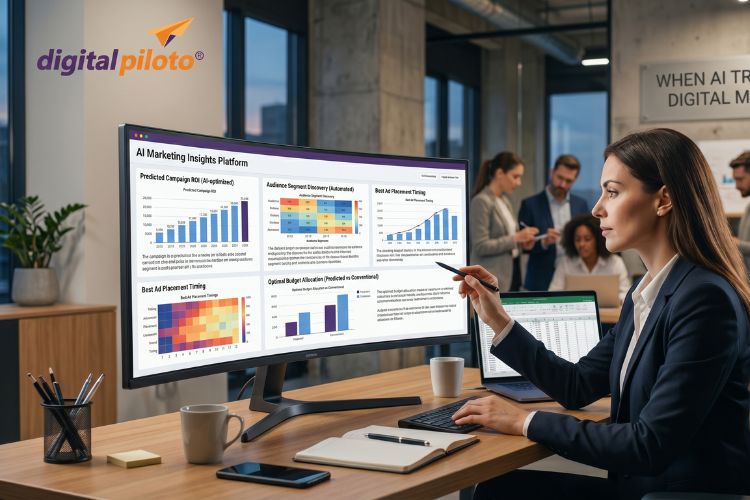

When AI meets digital marketing, the result is a smarter, faster, and more personalized approach to customer engagement. Artificial intelligence helps businesses analyze data, predict consumer behavior, automate repetitive tasks, and deliver highly relevant experiences at scale. Rather than replacing marketers, AI is reshaping how marketing strategies are created, executed, and optimized for better outcomes.
Today, organizations ranging from startups to enterprise brands are embracing AI-powered marketing tools. Whether partnering with a Digital Marketing Agency in Siliguri or managing campaigns internally, businesses are discovering that AI is becoming a competitive advantage rather than a future trend.
What Does AI Mean in Digital Marketing?
Definition
Artificial Intelligence in digital marketing refers to the use of machine learning, predictive analytics, natural language processing, and automation technologies to improve marketing performance and customer experiences.
AI systems can process vast amounts of data far faster than humans, enabling marketers to make informed decisions, identify patterns, and personalize campaigns with remarkable precision.
Why Is AI Changing Marketing So Quickly?
The answer is simple: modern consumers generate enormous amounts of digital data every day. Traditional marketing methods struggle to keep pace with this complexity.
AI excels at identifying trends hidden within customer behavior, helping brands understand what audiences want before they explicitly express it.
Several factors are accelerating AI adoption:
- Growing customer expectations for personalization
- Increased availability of behavioral data
- Demand for faster campaign optimization
- Advancements in machine learning technology
- Pressure to improve marketing efficiency
The businesses gaining the greatest benefits are those that use AI strategically rather than treating it as a shortcut.
How AI Improves Digital Marketing Performance
1. Better Audience Understanding
AI can analyze browsing patterns, purchase history, engagement metrics, and customer interactions to create highly accurate audience segments.
This allows marketers to move beyond assumptions and make data-driven decisions.
2. Hyper-Personalized Experiences
One of AI’s greatest strengths is personalization. Instead of showing the same content to every visitor, AI helps tailor recommendations, emails, advertisements, and website experiences to individual users.
Customers increasingly expect brands to understand their needs, and AI makes this possible at scale.
3. Smarter Advertising Campaigns
AI-powered advertising platforms continuously adjust bidding strategies, audience targeting, and creative delivery based on real-time performance data.
This often leads to improved conversion rates and reduced acquisition costs.
How AI Is Changing SEO and Search Visibility
Search engines themselves are becoming increasingly AI-driven. As a result, SEO strategies must evolve.
Modern optimization focuses on answering user questions clearly, demonstrating expertise, and creating content that both humans and AI systems can understand.
This is why many businesses now invest in generative engine optimization services to improve visibility within AI-generated search responses and conversational search experiences.
As answer engines become more influential, content quality and authority matter more than ever.
What Tasks Can AI Automate?
Bullet Explanation Format
AI can automate many repetitive marketing activities while allowing human marketers to focus on strategy and creativity.
- Email marketing optimization
- Customer segmentation
- Social media scheduling
- Ad campaign management
- Lead scoring and qualification
- Content recommendations
- Performance reporting
- Customer support chatbots
Automation creates efficiency, but successful brands still rely on human oversight to maintain authenticity and brand voice.
How Businesses Can Successfully Adopt AI
Step-by-Step Framework
Step 1: Define Business Goals
Start by identifying specific marketing challenges that AI can solve, such as lead generation, customer retention, or campaign optimization.
Step 2: Organize Your Data
AI performs best when it has access to accurate and structured data.
Step 3: Implement Relevant Tools
Select solutions that align with your objectives rather than adopting technology solely because it is popular.
Step 4: Combine AI with Human Expertise
Use AI for insights and efficiency while relying on marketers for strategic decisions and creative direction.
Step 5: Continuously Optimize
Monitor results, test new approaches, and refine campaigns based on performance data.
What Are the Risks of Over-Reliance on AI?
While AI offers tremendous advantages, it is not infallible.
Businesses that depend entirely on automation may encounter issues such as generic content, inaccurate recommendations, reduced creativity, and weakened brand differentiation.
The most effective marketing strategies combine AI’s analytical power with human judgment, empathy, and storytelling.
The Future of AI in Digital Marketing
AI will continue to influence nearly every aspect of digital marketing. Predictive analytics, conversational AI, marketing automation, customer journey optimization, and intelligent content creation will become increasingly sophisticated.
Many Digital Marketing Firms In India are already integrating AI into their services to improve efficiency, strengthen customer targeting, and enhance overall campaign performance.
The future is unlikely to belong to businesses that use the most AI. Instead, it will favor organizations that combine technology with genuine customer understanding.
Frequently Asked Questions
What is AI in digital marketing?
AI in digital marketing involves using machine learning, automation, and data analysis technologies to improve marketing effectiveness and customer experiences.
Can AI replace digital marketers?
No. AI can automate tasks and provide insights, but human creativity, strategy, and relationship-building remain essential.
How does AI improve customer personalization?
AI analyzes customer behavior and preferences to deliver tailored content, recommendations, and marketing messages.
What are the benefits of AI-powered marketing?
Benefits include improved efficiency, enhanced targeting, better personalization, faster decision-making, and optimized campaign performance.
Is AI important for future SEO strategies?
Yes. As search engines become increasingly AI-driven, businesses must create authoritative, user-focused content optimized for both traditional and AI-powered search environments.
Conclusion
AI is not simply changing digital marketing—it is redefining how brands connect with customers. The real opportunity lies in using AI as a strategic partner rather than a replacement for human expertise. Businesses that blend intelligent technology with authentic customer engagement will be best positioned to thrive in the evolving digital landscape.
Blog Development Credits:
This article was envisioned by Amlan Maiti, developed through advanced AI-supported research methodologies, and finalized with SEO refinement and strategic enhancements from Digital Piloto Private Limited.