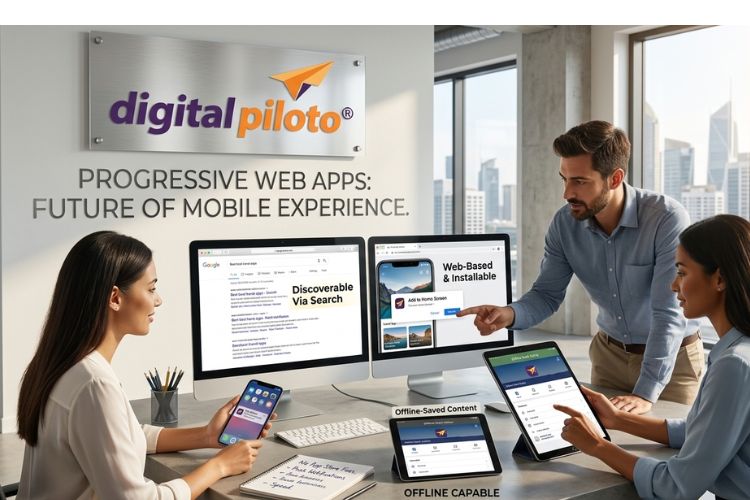

Progressive Web Apps (PWAs) are web applications that deliver fast, app-like experiences directly through a browser, combining the reach of websites with the performance of native apps. They load quickly, work offline, and can be installed without app stores—making them a powerful solution for modern mobile users. Businesses investing in Website Development Service in Durgapur are increasingly adopting PWAs to improve user engagement and conversions.
What Exactly is a Progressive Web App?
Definition
A Progressive Web App (PWA) is a type of web application built using standard web technologies like HTML, CSS, and JavaScript, enhanced with modern APIs to deliver a fast, reliable, and engaging user experience similar to native mobile apps.
Unlike traditional websites, PWAs can function offline, send push notifications, and be installed on a user’s home screen without requiring app store downloads.
Why Are PWAs Considered the Future of Mobile Experience?
The shift toward PWAs isn’t hype—it’s driven by real user behavior. People want speed, simplicity, and minimal friction. Native apps often fail here due to heavy downloads and storage constraints.
- Instant loading: PWAs use caching to load content almost instantly.
- No installation barriers: Users can access them via a URL.
- Cross-device compatibility: One app works across all devices.
- Lower development cost: No need for separate iOS and Android apps.
From my experience, businesses that switch to PWAs often notice a significant drop in bounce rates—because users simply don’t wait anymore.
How Do Progressive Web Apps Work?
Step-by-Step Explanation
- Service Workers: These background scripts cache resources and enable offline functionality.
- Web App Manifest: Defines how the app appears when installed (icon, theme, layout).
- HTTPS Security: Ensures data safety and trust.
- Responsive Design: Adapts seamlessly across screen sizes.
- App Shell Architecture: Loads the basic UI instantly while fetching dynamic content.
This combination creates a smooth, app-like interaction—without the weight of a traditional mobile app.
PWA vs Native Apps: What’s the Real Difference?
Let’s be honest—native apps still dominate certain areas like gaming or heavy processing. But for most business applications, PWAs are more efficient.
- Installation: PWAs don’t require app store downloads.
- Updates: Automatic in PWAs, manual in native apps.
- Cost: PWAs are significantly cheaper to build and maintain.
- Reach: PWAs are instantly accessible via search engines.
This is why many businesses working with a Web Design Company In India are prioritizing PWAs over native app development.
Real-World Use Cases of PWAs
PWAs are not theoretical—they’re already transforming user experiences across industries.
- E-commerce: Faster checkout and improved mobile conversions.
- News platforms: Instant loading even with poor connectivity.
- Travel websites: Offline access to booking details.
- SaaS platforms: Seamless performance across devices.
One key insight: PWAs work exceptionally well in regions with slower internet speeds, making them ideal for emerging markets.
Key Benefits of Progressive Web Apps
- Speed: Lightning-fast loading improves user retention.
- Offline functionality: Users stay engaged even without internet.
- SEO-friendly: Indexed like regular websites.
- Higher engagement: Push notifications drive repeat visits.
- Cost-effective: Single codebase reduces development costs.
In practical terms, PWAs bridge the gap between user expectation and business performance.
Are There Any Limitations of PWAs?
Yes—and ignoring them would be unrealistic.
- Limited access to certain device features (compared to native apps)
- iOS support is improving but still slightly restricted
- Not ideal for complex, hardware-heavy applications
However, for most businesses focused on user experience and conversions, these limitations are minor.
How to Decide If Your Business Needs a PWA?
Ask yourself:
- Do users frequently access your platform on mobile?
- Is speed affecting your bounce rate?
- Do you want to reduce app development costs?
- Are you targeting users with inconsistent internet access?
If the answer is “yes” to even two of these, a PWA is worth serious consideration.
FAQs About Progressive Web Apps
1. Are PWAs better than native apps?
PWAs are better for accessibility, cost, and speed, while native apps are stronger for advanced features and performance-heavy tasks.
2. Do PWAs work offline?
Yes, PWAs use service workers to cache data, allowing them to function even without an internet connection.
3. Can PWAs be indexed by Google?
Absolutely. PWAs are SEO-friendly and can be indexed just like traditional websites.
4. Are PWAs secure?
Yes, they are served over HTTPS, ensuring secure data transmission and user trust.
5. Do users need to install PWAs?
No installation is required, but users can optionally add them to their home screen for quick access.
Conclusion
Progressive Web Apps aren’t just a trend—they’re a practical evolution of how users interact with digital platforms. If your goal is speed, reach, and seamless experience, PWAs offer a balanced, future-ready solution without the complexity of native apps.
Blog Development Credits:
This blog idea was originally shaped by Amlan Maiti, then thoughtfully researched and expanded using advanced AI platforms like ChatGPT, Gemini, and Copilot, with final SEO refinement by Digital Piloto Private Limited.